LisbonLisboaPortugal.com
The best independent guide to Lisbon
LisbonLisboaPortugal.com
The best independent guide to Lisbon
How to Get to Lisbon Castle and the 737 bus
There is no getting around it: the Castelo de São Jorge sits on the highest hill in Lisbon, and every route up involves some effort. But the amount of effort varies enormously depending on which route you choose, and picking the right one can make the difference between arriving hot, frustrated, and already half-done with your visit, or stepping through the gates feeling like you have earned it without destroying your legs in the process.
Below is every option for reaching the castle, from the 737 bus that does all the work for you to a local shortcut using two free lifts that most visitors never find. If you are looking for information on tickets, opening hours, and what to see once you are inside, that is all covered in my full guide to the Castelo de São Jorge.
The 737 bus
The simplest and most reliable way to reach the castle. The 737 departs from Praça da Figueira in the Baixa and loops through the tight streets of Alfama, dropping you on the Rua do Chão da Feira just below the outer castle walls. From there it is a short walk through the Arco do Castelo to the ticket office. The bus is large, air-conditioned, and how it navigates the narrow cobbled streets without clipping wing mirrors off every building it passes remains one of Lisbon's small mysteries.
The route passes the Igreja de Santa Maria Madalena, the Sé Cathedral, and Limoeiro before reaching the castle, so you get a taste of the old city along the way. It follows roughly the same path as the famous number 28 tram through Alfama, but with one significant advantage: the bus is rarely full, and you will almost always get a seat, whereas the tram during peak season can be impossible to board.

The 737 bus waiting outside the castle walls. I have no idea how such a big bus can navigate the tight streets of Alfama.
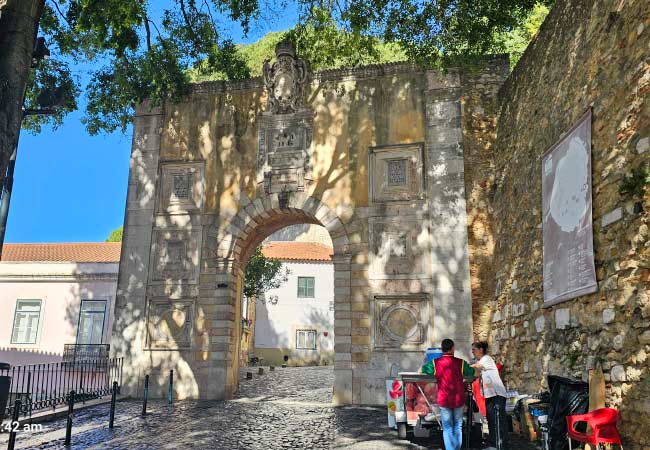
From the bus stop walk through the Arco do Castelo to enter the castle complex
Finding the stop: The departure point in Praça da Figueira is on the northwestern side of the plaza. There is an electronic display showing when the next bus is due, which takes the guesswork out of waiting. Departures are frequent, roughly every 10 to 15 minutes during the day on weekdays, and only slightly less often on weekends and holidays. For the latest timetable, check the Carris website at carris.pt.
Paying for the bus: A single ticket costs €2.10. You can pay the driver in cash or tap a bank card (or phone with NFC) on the validator terminal by the door. The validator also lets you buy tickets for up to 10 passengers in your group, which is handy if you are travelling as a family.
A money-saving tip if you are in Lisbon for more than a day: Pick up a Navegante card and load it with credit using the system known as Zapping. This drops the single fare to €1.72 and works across all Lisbon public transport: buses, trams, metro, and ferries. You simply tap the card when you board and the fare is deducted automatically. It removes the hassle of buying individual tickets, avoids fumbling for change on a crowded tram, and saves money on every journey. When friends visit me in Lisbon, I hand them a Navegante card loaded with about €15 of Zapping credit. It is one of those small things that makes the entire trip smoother, and they always thank me for it by the second day.
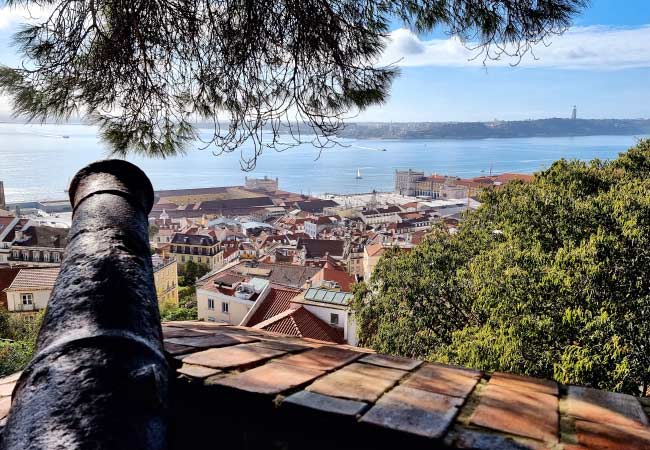
The view from the castle walls over the Tejo
Walking to the castle
I would always choose to walk over taking public transport for a distance this short, especially when the route passes through some of Lisbon's most fascinating streets. When I was gathering photographs for this guide, the 737 bus was literally waiting in Praça da Figueira and I still chose my legs. The walk is part of the experience.
There are two routes worth knowing about. The first is a slightly longer, scenic route that follows the tram lines and is almost impossible to get lost on. The second uses two free lifts to remove most of the climbing, but requires a bit of local knowledge to find. Both start from the Baixa.
The scenic route (following the tram lines)
From the Baixa, find the number 28 tram tracks running along the Rua de São Julião. The tracks cut across Rua Augusta in an east-west direction, and once you have spotted them, you simply follow them eastwards and uphill into Alfama. That is your entire navigation strategy, and it works perfectly.
The route climbs steadily through some of the most photogenic parts of the old city, passing the Sé Cathedral and the Church of Saint Anthony along the way. You are sightseeing as you walk rather than just grinding uphill through residential backstreets, which makes the effort feel worthwhile rather than purely functional.
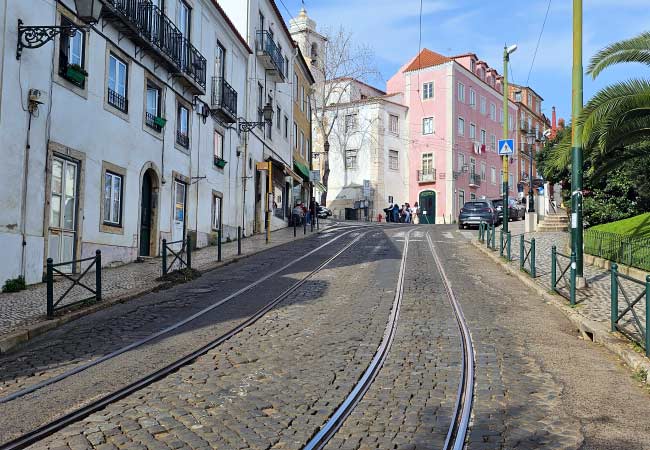
Follow the tram track from Baixa to Alfama as it climbs the Colina de São Jorge (Saint Geroge hill)
The tram tracks eventually bring you to Largo das Portas do Sol, which is one of my favourite spots in the city and a wonderful viewpoint in its own right. It is worth pausing here before the final push. From the largo, the direct route to the castle is up the narrow Travessa de Santa Luzia. There are signs, and you will almost certainly be walking alongside a steady stream of fellow tourists heading the same way, so getting lost at this stage is unlikely. The travessa brings you out where the 737 bus drops off passengers, just below the castle walls.
Allow around 25 minutes from the Baixa, more if you stop at the cathedral or linger at the viewpoint. For a first visit to Lisbon, this is the route I would recommend. The starting point is easy to find (just look for the tram tracks), you pass several major landmarks along the way, and the only real navigation required is to keep following the rails.
The two free lifts (the local shortcut)
This is the route most visitors never discover, and it is the one I use when I am heading to the castle without wanting to sightsee along the way. It takes around 15 minutes from the Baixa and eliminates most of the climbing. The trade-off is that the starting point is hidden in plain sight, and the route through the backstreets requires more confidence than simply following tram tracks.
The first lift is the Elevador da Baixa (but commonly called Elevador Castelo) and is tucked inside a beautifully restored Pombaline building on Rua dos Fanqueiros (numbers 170 to 178). Do not expect anything obvious. The entrance looks like a regular shopfront or apartment doorway, and most people walk straight past without realising there is a free public lift inside. Step in, ride up, and you emerge on Rua da Madalena having skipped a decent chunk of elevation in about thirty seconds.
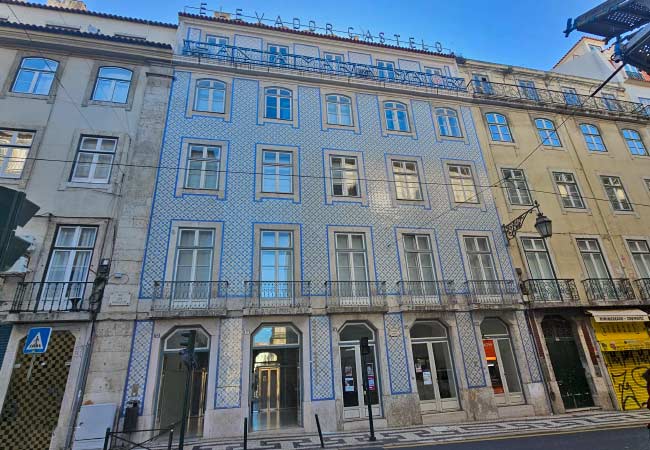
The Elevador Castelo is easy to walk past and not realise if the doors are shut – I have done this many times had to cross back over the road and look for the giant “Elevador Castelo” sign on top of the building!
The second lift is in the Chão do Loureiro building (called the Elevador do Mercado), across the street and slightly uphill on the Largo Chão do Loureiro. Look for the Pingo Doce supermarket and the parking garage; the lift is inside the same building. It carries you up to the Miradouro do Chão do Loureiro, another free viewpoint, and it does not cost a thing.
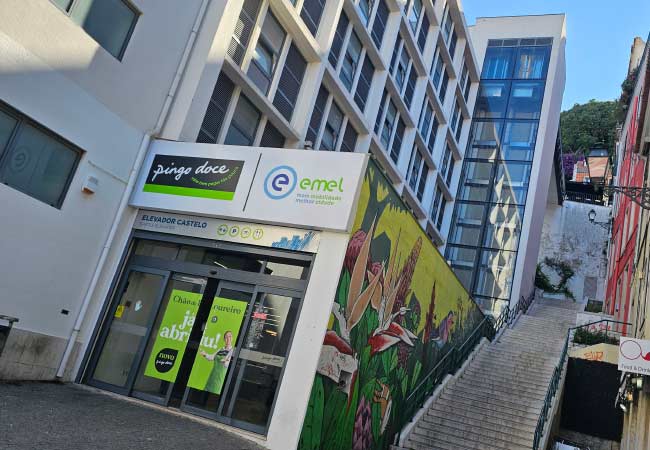
The entrance to the Elevador do Mercado and the Pingo Doce supermarket
From here, turn right onto the Costa do Castelo and follow it along. This stretch is flat and pleasant. There is only one hill street left to deal with: the Rua Bartolomeu de Gusmão, which brings you out at the 737 bus stop near the castle entrance. After two free lifts, this final slope feels like a minor inconvenience rather than a proper climb.
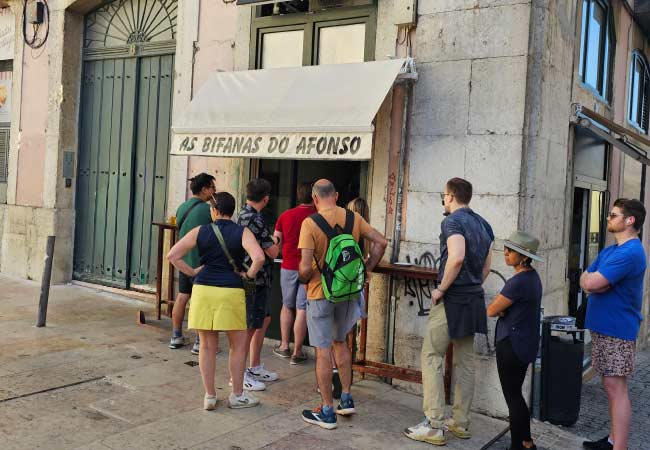
As Bifanas do Afonso is along this stretch of the route as well, a tiny, no-fuss spot on the Costa do Castelo that does a properly good bifana. I would take it, if the queue is not too long, which it usually is.
One honest warning about this route: the streets between the two lifts are narrow, winding, and not well signposted. Like any walking route through Alfama, a wrong turn is easy to make and can send you in entirely the wrong direction. If you can find the two lifts and remember to turn right at the top of the second one, the rest falls into place. But if you are someone who gets frustrated when navigation goes sideways, the tram line route might be the less stressful option.
Uber or Bolt up to the Castle
A ride from the Baixa costs around €4 and drops you right at the castle entrance. On a hot day, with tired legs, or if you are travelling with small children, this is the option that nobody regrets choosing.
That said, it is not always as quick as it sounds. The Baixa is a maze of one-way systems, and Uber and Bolt drivers regularly get stuck in traffic or struggle to find the exact pickup point. You can end up standing on a street corner watching your driver loop around the block on the app screen, and by the time they arrive and navigate up the hill, the whole process can take almost as long as walking the two-lift route yourself.
A better use of a rideshare, and something I do whenever I am sightseeing with friends or family: take an Uber to the highest point of your day and then walk downhill from there. For most of my Lisbon walking routes, that means getting dropped in Graça, which sits above Alfama and the castle. You visit the castle on the way down rather than hauling yourself up to it, and the rest of your sightseeing through Alfama flows naturally downhill from there. If you are planning further sightseeing after the castle, this approach saves far more energy than using a rideshare just to get to the entrance.
The number 28 tram
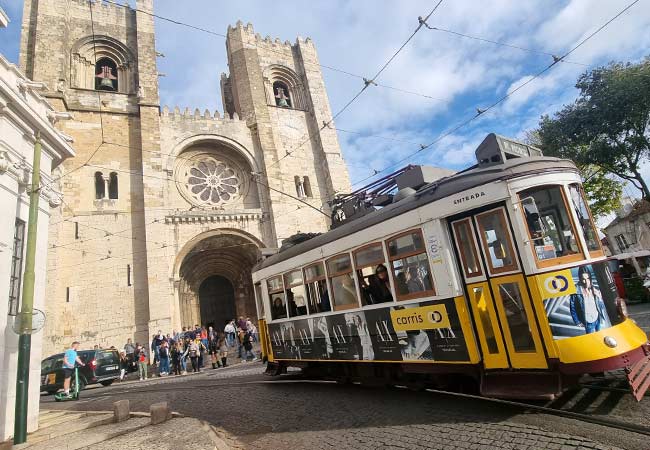
I need to be honest about this one. The 28 tram is iconic, and riding it is a Lisbon experience in its own right, but as a way of getting to the castle it is not ideal. The nearest stop is Largo das Portas do Sol, which still leaves you with a steep uphill walk. During peak season, the tram itself is so packed with tourists that actually boarding it can be a challenge in its own right. If you want to ride the 28, do it for the experience on a separate occasion. Do not rely on it to get you to the castle on time. If you want public transport, take the 737 bus.
Discover more of Lisbon with our most popular guides


About this guide: I'm Philip Giddings. I live in Graça with my Portuguese wife Carla, whose family are Lisboetas going back generations. I've been visiting Portugal since 2001, writing the independent guides at LisbonLisboaPortugal.com since 2009, and the site is now my full-time work. Carla first brought me up to Lisbon on an early trip, and twenty-five years on we are still walking the city together: summers on the packed beaches, quiet Saturdays at the Feira da Ladra, and hunting for a heater for our flat when the chilly winter arrives.
This site has 189 guides on Lisbon. It takes no payment from tourist boards, tour operators, or attractions for inclusion, and is funded by affiliate commissions on tour bookings, disclosed on every page that contains them. Every practical detail (ticket prices, opening hours, bus routes, time-slot policies) is checked against the official sources and verified in person on the walks I make through the city each week. Read the full story here.