LisbonLisboaPortugal.com
The best independent guide to Lisbon
LisbonLisboaPortugal.com
The best independent guide to Lisbon
The number 28 tram of Lisbon; a locals guide for 2026
The number 28 tram trundles past my flat window in Graça every 20 minutes, its yellow carriage crammed full of tourists, each wanting to experience Lisbon's most famous activity. I will not deny that the ride is memorable, as the little tram rattles through the popular districts of Alfama, Baixa, Estrela and my own Graça.
When I first visited as a tourist 25 years ago, I rode it with glee and excitement, so I appreciate what the draw of it was, and still is. The famous sights, the polished wood interiors, the brass dials and the cheery yellow paintwork. In any other city these trams would be housed in a museum, but in Lisbon they are an integral part of the public transport network, and, unfortunately, my only option for public transport from my flat.
These historic trams are still in use because the number 28 route is completely unsuitable for modern trams (such as those on the 15E route to Belém), due to its numerous tight turns, narrow streets and steep gradients. Along with the hills, twists and turns, the 28 follows a very scenic route, passing many of Lisbon's historic sights, such as the Sé Cathedral, the Portas do Sol viewpoint, the Assembleia da República and the Basílica da Estrela.
Having lived in the Graça district for five years and used the tram almost daily, this guide is based on my first-hand experience as both a local resident and a visitor, taking my nieces and nephews on it for the tourist experience. I will cover fares, tips for getting the most from your journey, and the key sights along the route.
Related articles: Alfama guide - Baixa guide
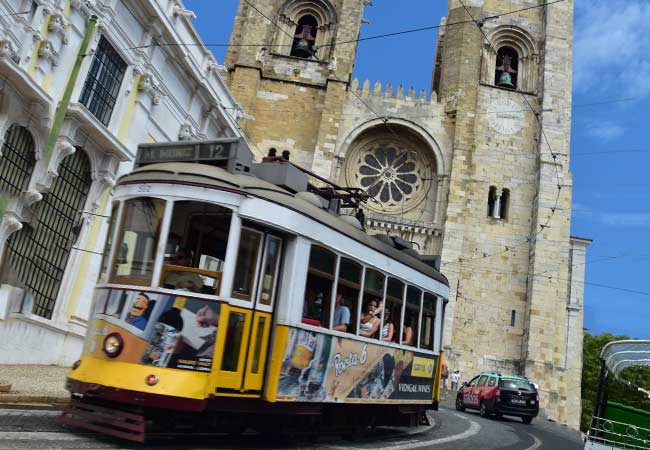
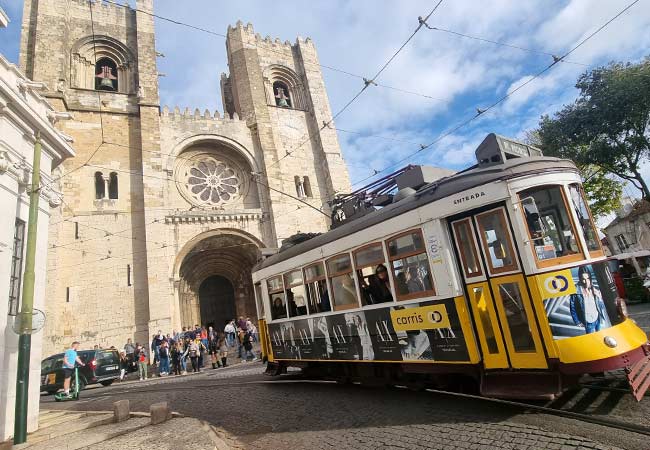
The classic photo of Lisbon of the 28 tram passing the Sé cathedral
Quick details for the 28 Tram
Before I launch into the full details about the tram, its route and sights, here are some quick details to answer any immediate questions you may have:
Onboard ticket price: €3.30
Cheapest fare: Zapping, €1.72 (explained in detail later)
Bank card: contactless payment can be made using the ticket validator. (I would always carry cash as a backup.)
Service: every 10 minutes (8am to 7pm), with a reduced service continuing until 10:30pm at weekends and 11:30pm on weekdays. In reality the service is unpredictable mid-route, as there is always traffic or a car blocking the track in the Alfama section, where many trams get held up. I have waited 40 minutes for a tram and then had three arrive at once.
Most scenic section: Graça to Praça Luís de Camões. Both of these points sit at the top of hills, so getting off at either means you will be walking downhill.
Best time to ride: 7:00 to 8:00am, or after 7pm. Put simply, it is packed all day, every day.
The 28 tram route: Martim Moniz - Intendente - Graça - Portas do Sol (Alfama) - Sé Cathedral - Rua da Conceição (Baixa) - Praça Luís de Camões (Chiado) - São Bento - Estrela - Prazeres (Campo de Ourique)
The interactive map I created displays the tram route along with the major tourist attractions.
Legend: 1) Basílica da Estrela 2) Assembleia da República 3) Praça Luís de Camões 4) Rua Augusta 5) Praça do Comércio 6) Igreja de Santo António 7) Sé de Lisboa 8) Portas do Sol 9) Mosteiro de São Vicente 10) Graça 11) Castelo de São Jorge
In my experience, the busiest section is between Praça Luís de Camões and Martim Moniz. Interestingly, the westbound direction is always busier with tourists, as they prefer to board at the route's starting point in Martim Moniz. Queues there can be very long, with waits of over 30 minutes to board.
Note: The tram does not stop outside the castle. From the Portas do Sol tram stop, it is a steep uphill walk to the castle entrance. The closest public transport to the castle is the 737 bus route, which departs from the Praça da Figueira.
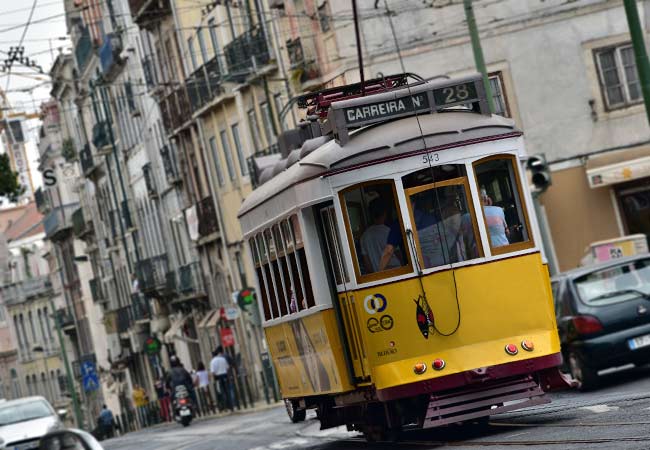
Passing through São Bento; this is where the E28 finally picks up speed after the narrow streets of Alfama.
Tram 28; getting the most from the experience
A ride on the number 28 tram is one of the highlights of Lisbon, but its popularity means it frequently suffers from over-tourism. Here I are some simple tips I recommend to friends and family so they can get the most from the experience:
• Ride the tram early (or late) in the day, to avoid the mid-day crowds.
• Ride the quieter western section from Praça Luís de Camões to Campo de Ourique for a chance to get a seat.
• Always be wary of pickpockets (please see later section).
• Purchase a Zapping credit or 24-hour public transport ticket from any metro station, which removes the hassle of buying a ticket on board and is much better value for money.
• Ride the entire route, as there is so much to see.
• If standing, hold on tight, as the brakes are very sharp!
Insight: If you just want to ride a traditional tram and are not bothered by the route, choose the E24, which connects the Praça Luís de Camões to Campolide. This tram never has any queues and seats are always available. For a guide to the E24 tram please click here.
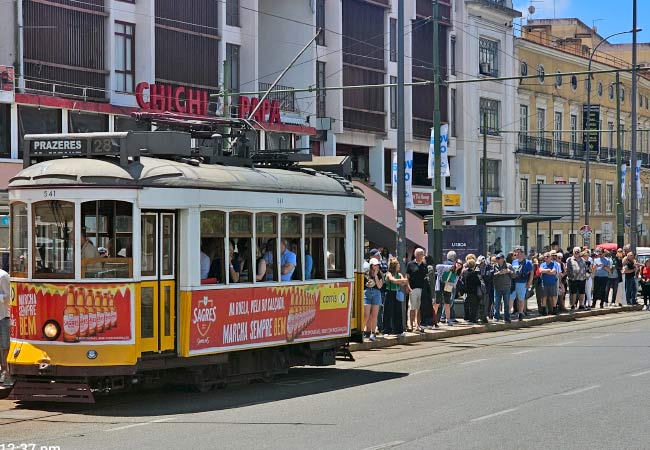
The queue to board the tram in Martim Moniz at 11am, on what I thought would be a quiet Wednesday in July. This queue is even longer when a cruise ship docks.
The number 28 tram route is identified as the E28 with the preceding “E” meaning Elétrico (the Portuguese for tram).
Fares and better options
A single ticket purchased on board the tram costs €3.30.
Cash tickets are bought from the driver. Alternatively, if you are using a bank card (Visa or Mastercard only), you can pay at the validator terminal located near the entrance. The validator terminal only accepts bank cards (or mobiles with NFC technology), while the driver only accepts cash, not cards. Using the validator terminal, you can buy tickets for up to 10 passengers in your group.
The single fare is convenient if you are only going partway, but if you plan to travel to the end at Prazeres and back, you will need two single fares, totalling €6.60. Lisbon has some of the cheapest public transport in Europe, and there are much cheaper ways to ride the 28 tram.
If you are planning to do a lot of sightseeing in a single day, my suggested option is the 24-hour unlimited public transport ticket, which costs €7.25. The annoyance with this ticket is that it cannot be bought on board the tram and has to be purchased from a metro station. This 24-hour ticket is great value for visitors, as it includes travel on the Elevador de Santa Justa (€6.20 return), the funiculars (€4.30 single) and all of the tram routes (€3.30 each).
The option I use all the time is to pay for public transport is "Zapping". This pre-loads credit onto the Navegante card, which can be used on public transport across the Lisbon region. The Zapping fare is much cheaper, costing only €1.72 for a single tram ride. If you are in Lisbon for a few days, I suggest getting a Navegante card with €15 of credit loaded, which can be used everywhere, including the train to Sintra and the ferries.
Personal insight: when friends come to Lisbon, I give them a Navegante card loaded with €15 of Zapping credit. This removes the hassle of trying to buy tickets on the trams, or worrying about having enough cash.
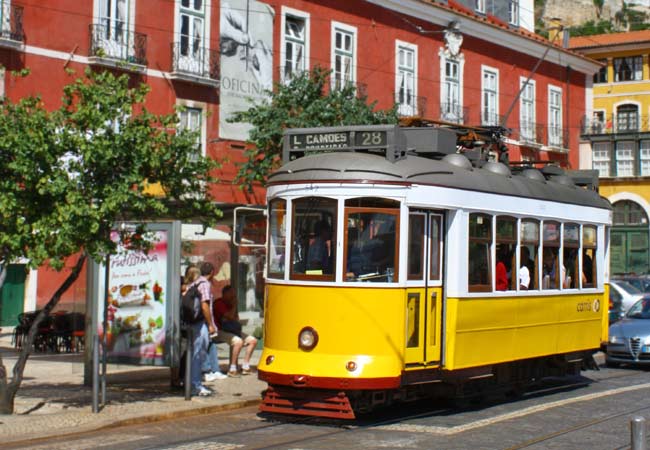
The tram at the Portas do Sol stop, one of the moist scenic points of Lisbon.
Is a small group tour worth it?
One of the smartest things you can do in your first day or two, while you are still finding your bearings, is to join a small group tour. A good guide does in a few hours what takes days to work out alone: which viewpoints are worth the climb, where to find a genuinely good restaurant and how to make sense of the city's tangle of hills and neighbourhoods.
I have worked with GetYourGuide for seven years, and I have taken several of their Lisbon tours myself. These are the ones I would happily point a friend towards:
The links above are affiliate links, and I earn a small commission if you book through them. I really appreciate it, as it helps me keep this website running.
Pickpockets and the 28E tram
It makes me sad, but I must write a section about the skilful pickpockets who plague the tourist areas and the tram routes. These pickpockets are skilful opportunists who only target tourists who fail to use common sense or are simply being careless.
While standing on a packed tram, never keep anything valuable in a back pocket, and wear rucksacks and bags on your front. Pickpockets tend to target the most crowded trams and people near the exits. Their common tactic is when people are entering or leaving the tram, using the jostling of the crowd as cover. The pickpockets are as likely to be women as men, are usually dressed to blend in, and often work in groups of two or three.
None of this should put you off riding the tram but encourage you use the same common sense you would at home.
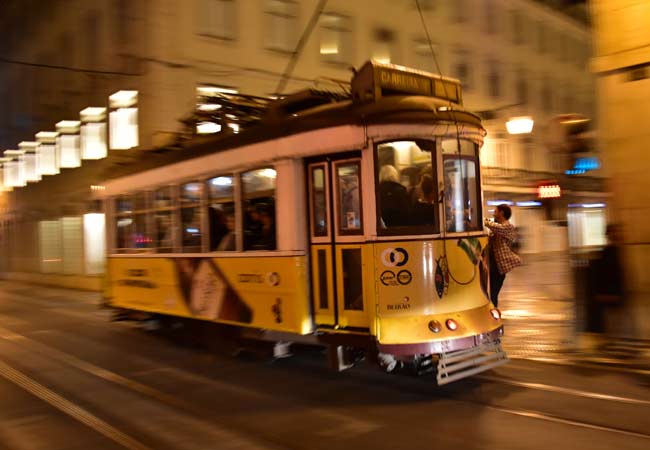
I watched this ‘Tram Surfer' hanging off the back of the tram as it wizzes through Baixa.
Tourist attractions along the E28 Tram route
The number 28 tram passes through many of the most interesting districts of Lisbon, and this section details what I consider are the best sights for visitors along the route.
Basílica da Estrela (Estrela stop): Lisbon's standout religious building, built to fulfil a vow Queen Maria made in 1760 for a male heir. This Neoclassical basilica dominates the western Lisbon skyline, with its huge dome flanked by twin bell towers. The grand gesture did not bring Queen Maria good fortune, as her son, Prince José, died of smallpox aged 27, two years before the basilica was completed. A visit here includes access to the roof with its views and a narrow walkway inside the upper levels of the dome.

The tram in front of the Basílica da Estrela
Portas do Sol is a lively plaza built on what was once the eastern gate into the city, and hence the name Gate of the Sun. It is the only truly open space in Alfama, with views down the hill to the waterfront and the cruise terminal where the huge ships moor.
There is always a tourist buzz about the place: photos being taken, a pastel de nata from Manteigaria, and laughter drifting over from the Piña Colada bar. My wife, on the other hand, being Portuguese, is irritated by it all: the crowds, the constant barrage of tuk-tuk drivers touting tours, the inflated prices at the kiosk. Even so, she will always stop for a selfie at the viewpoint. This is the best place to begin exploring Alfama, and my suggestion is to head down the steps of the Rua Norberto de Araújo.
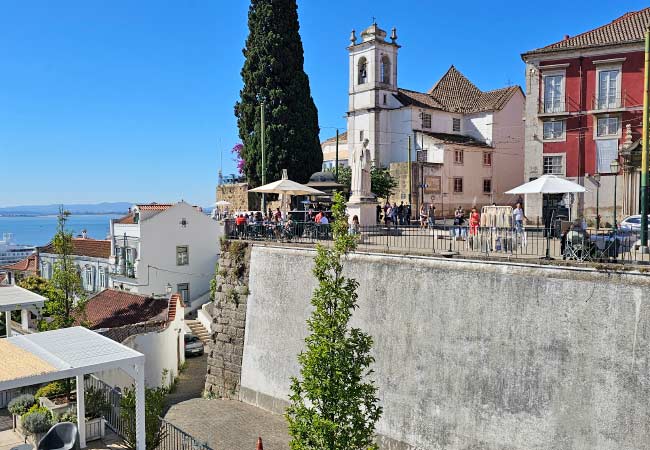
Graça: My home neighbourhood, which feels like small-town Portugal within the city. The high street reflects this mix, where trendy eateries sit next to traditional coffee shops where my mother-in-law would spend all day chatting. Being the highest point of the city, the neighbourhood has some of the best view points of Lisbon. Guide to Graça
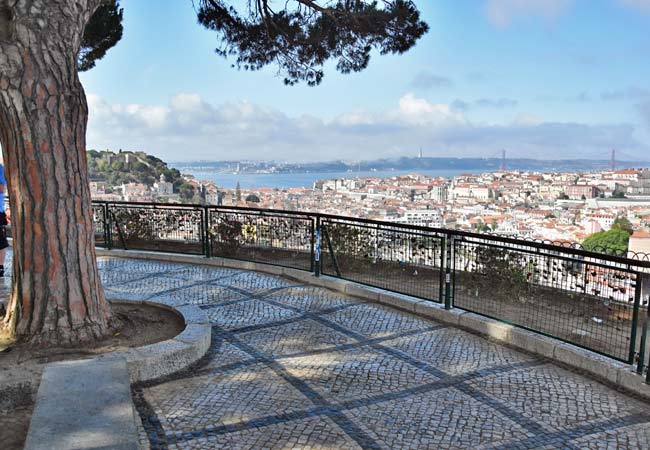
The Miradouro da Senhora do Monte is the highest point of central Lisbon
São Bento: The setting for the Portuguese parliament, which is housed in the grand Assembleia da República. This is another underrated and little-visited district of Lisbon that is worthy of a detour from the common tourist areas.

The Assembleia da República in São Bento
Praça Luís de Camões: The main plaza of Bairro Alto, a bustling square where there is always something going on. The narrow streets of Bairro Alto come alive at night with funky bars and trendy hangouts, and at the weekends, the socialising spills out onto the streets.
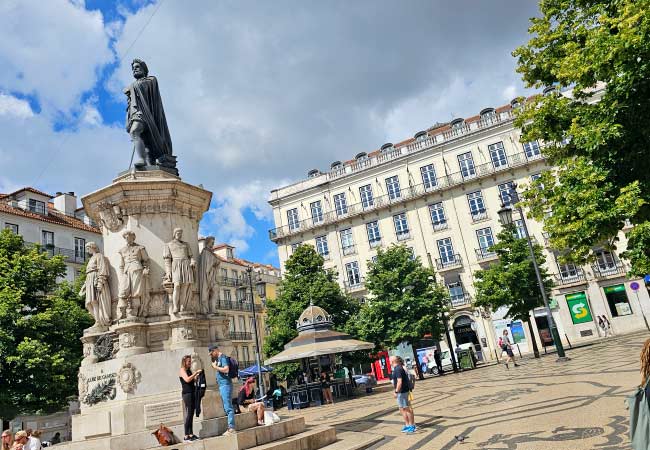
The Praça Luís de Camões
Rua da Conceição: The tram stop on the southern side of the Baixa district, close to the pedestrianised Rua Augusta and the Praça do Comércio, Lisbon's finest plaza.
Sé Cathedral: Tram stop outside the ancient Sé Cathedral and Saint Anthony Church. Saint Anthony is the patron saint of Lisbon (along with lovers and lost causes), and the Igreja de Santo António was built on his birthplace.
Intendente: A multicultural and diverse part of the city. Some visitors will embrace the diversity, while others will think it a bit shabby, with dodgy characters.
Alternative tram routes to the E28
From my experience, many friends and family want to ride one of the traditional yellow trams, but when I discuss it with them, they are not that interested in the route. If you fall into this category, I suggest taking the much quieter but equally interesting E24 tram. There is never a queue to board it, and there are often seats for the entire route. The tram starts at the Praça Luís de Camões and heads north to Campolide, passing through Bairro Alto and Príncipe Real.
While in Campolide, head to the top floor of the Amoreiras shopping centre for the Amoreiras 360 viewpoint (€5), which offers one of the best views of Lisbon.
Related article: The number 24 tram
The E12 tram is a shorter route from Martim Moniz to Praça Luís de Camões that follows much of the E28 through Alfama and Baixa but skips the Intendente and Graça section. It departs from the same location as the E28 in Martim Moniz, and often doesn't have a long queue, as most tourists don't know where it heads. If there is a long queue for the E28 and the E12 appears, I’d recommend jump on it.
Related article: The number 12 tram
Departures and Journey Times
The 28 tram is an important part of Lisbon's public transport network, and the only real public transport passing through the Graça and Alfama districts. This importance is reflected in the frequency and operating hours of the service.
The trams start early in the day (6am) and continue late at night (11.30pm weekdays, 10.30pm at the weekend), with at least seven departures per hour between 9am and 6pm. For the latest timetable, please see the Carris website at:
www.carris.pt/en/travel/carreiras/28e/
At all major tram stops, there are digital information boards that provide up-to-date departure times. These screens are much more useful than the printed timetables, owing to the frequent delays.
The trams experience frequent delays passing through Alfama, due to heavy traffic or badly parked cars blocking the route. It is not uncommon to wait 20 minutes for a tram and then have three come through in one go.
My Personal experience of the 28 tram
I live in the Graça neighbourhood of Lisbon, and the number 28 tram is my main public transport connection, as there is no metro close to the area and only limited bus services. The 28 trundles past the window of my flat, but I have a love/hate relationship with it, in part due to the demands of tourism. I also have a local's perspective through my mother-in-law, who frequently travels on it to see us, as she has the free pensioner's pass.
The 28 tram is so lovely to ride in October or November, early in the morning, when I am travelling to the other side of the city to see friends around Estrela. I can get a seat, there isn't too much traffic through Alfama, and there is nothing better than watching the sights rattle past. The route isn't particularly useful for getting elsewhere around the city, as it doesn't connect to the metro, and so I do what so many young people do and hail an Uber or Bolt.
The sad part is that from May to September I don't even consider using the tram as public transport, as I know I will struggle to board, let alone get a seat. This means I either walk 15 minutes down the hill to Martim Moniz metro or, once again, hail an Uber.
For my mother-in-law the experience is much worse. The 28 is the only public transport up the hill to Graça, and she has stood for over 40 minutes at the initial tram stop at Martim Moniz. On the couple of occasions she was with my young nieces (aged 3 and 5), the tram driver let her skip much of the queue, but she felt rather self-conscious under the glares of those waiting, who were mostly tourists.
So I love seeing the 28 tram, and I am happy it is the icon of Lisbon, but I simply avoid using it as my local means of public transport. So much so that neither my wife nor I hold the residents' unlimited travel pass, and we rely mostly on Uber or Bolt, with all the traffic and pollution implications that entails.
The Remodelado trams
The little yellow Remodelado trams date from the 1930s and are bursting with traditional charm, from the original dials and levers through to the uncomfortable polished wood benches.
These trams are called Remodelado (re-modelled) because they were upgraded with improved brakes and electrics during the 1990s.
Discover more of Lisbon with our most popular guides


About this guide: I'm Philip Giddings. I live in Graça with my Portuguese wife Carla, whose family are Lisboetas going back generations. I've been visiting Portugal since 2001, writing the independent guides at LisbonLisboaPortugal.com since 2009, and the site is now my full-time work. Carla first brought me up to Lisbon on an early trip, and twenty-five years on we are still walking the city together: summers on the packed beaches, quiet Saturdays at the Feira da Ladra, and hunting for a heater for our flat when the chilly winter arrives.
This site has 189 guides on Lisbon. It takes no payment from tourist boards, tour operators, or attractions for inclusion, and is funded by affiliate commissions on tour bookings, disclosed on every page that contains them. Every practical detail (ticket prices, opening hours, bus routes, time-slot policies) is checked against the official sources and verified in person on the walks I make through the city each week. Read the full story here.