LisbonLisboaPortugal.com
The best independent guide to Lisbon
LisbonLisboaPortugal.com
The best independent guide to Lisbon
Parque Eduardo VII park: a visitor's guide for 2026
To many visitors the Parque Eduardo VII appears as a pleasant but unremarkable city park, the kind of place you might jog through but would not plan a morning around. However, that impression is wrong, and it took me many years of visiting Lisbon to actually appreciate it for what it is.
This is the largest park in central Lisbon, covering 26 hectares of sloped land that stretches from the top of the Avenida da Liberdade to a hilltop ridge overlooking the entire city. Inside its boundaries you will find a greenhouse built inside a flooded quarry, a pavilion that was originally constructed in Brazil and shipped across the Atlantic in pieces, along with one of the finest viewpoints in the city.
Having visited and lived in Lisbon since 2001, I have come to regard Parque Eduardo VII as one of my favourite green spaces in the city, a wonderful place to visit once the crowded streets and claustrophobia of central Lisbon get too much for you. On a warm afternoon, the shaded sections along the sides of the park are surprisingly peaceful, a world away from the crowds in Alfama or the Baixa just a short walk south.
Insight: My key advice for visiting the park: start from the top and work your way down. Do not try to walk uphill. There is a metro station at the top (São Sebastião), or for convenience get an Uber or Bolt and let the walk take care of itself downhill. This route is part of my favourite walks in the city, beginning at the Miradouro do Parque Eduardo VII and strolling all the way down to Rossio.
This guide will show you why this is one of my favourite parks in Lisbon, along with what to see and how to get the most from your time here.
Highlights of Parque Eduardo VII
Miradouro do Parque Eduardo VII
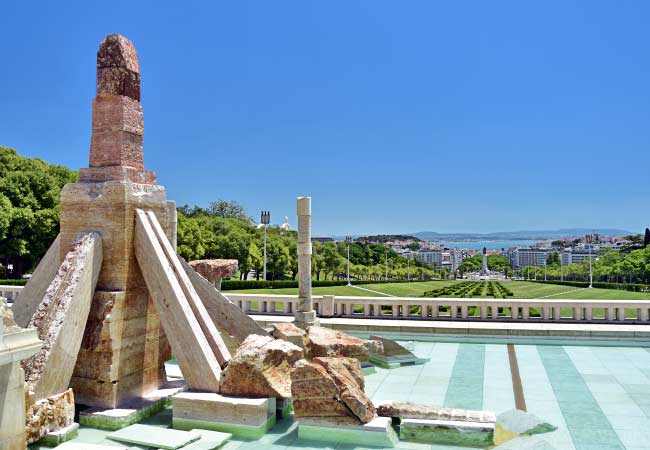
The viewpoint at the top of the park is the main draw for most visitors. Its wonderful view looks out over the formal gardens and down towards the Marquês de Pombal roundabout, with the Tagus visible on a clear day. The large "LISBOA" letters up here have made it a popular spot for photos, but the actual site is still peaceful and calm compared to all of Lisbon's other famous viewpoints. Be aware that the view is more about the sweeping panorama than spotting famous buildings.
Estufa Fria
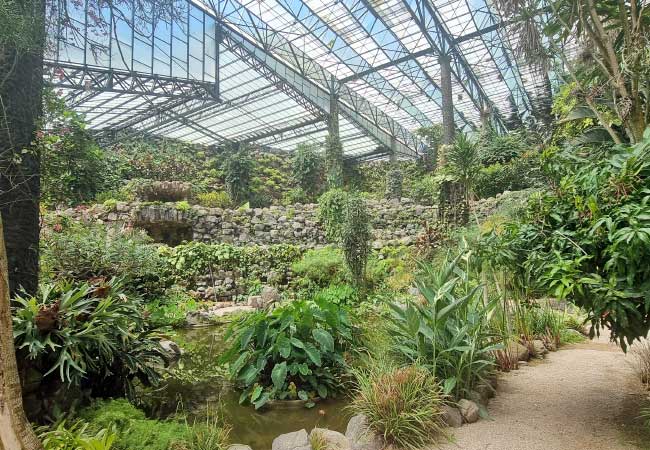
A greenhouse built inside a former basalt quarry, hidden in the northwestern corner of the park. When a natural spring flooded the old mining site, the city filled it with plants from five continents and covered it with a wooden lath roof instead of glass. The result is a hidden tropical garden right in the centre of Lisbon. Many guides refer to it as “a hidden gem of Lisbon” and I wholeheartedly agree.
Carlos Lopes Pavilion
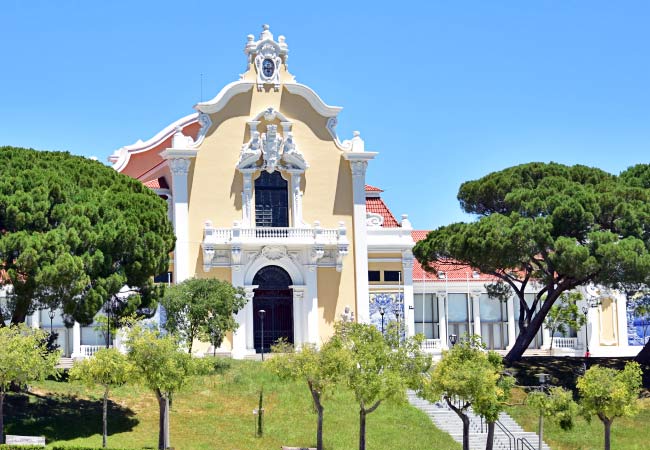
This high-end conference centre has been beautifully restored to its former grandeur, with its exterior covered in beautiful azulejo tile panels depicting scenes from Portuguese history. The real uniqueness of the building is that it was shipped twice across the Atlantic Ocean for the 1922 International Exposition in Rio de Janeiro – once from Lisbon to the exposition and then back to where you see it today. The pavilion is named after Carlos Lopes, who won Portugal's first Olympic gold medal in the marathon at the 1984 Los Angeles Games.
A green escape from the city
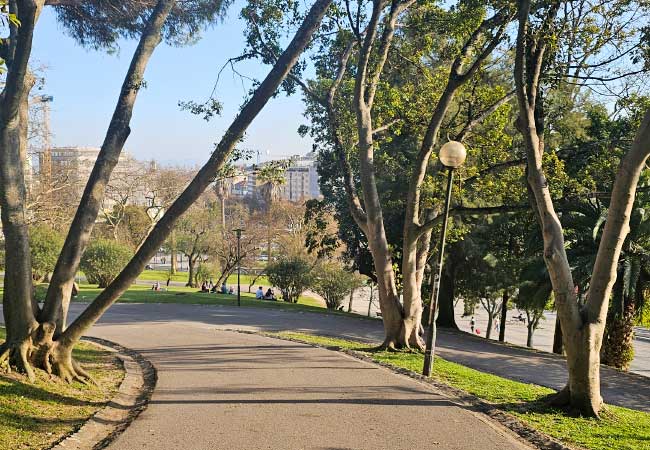
For all the history and the landmarks, sometimes the best thing about Parque Eduardo VII is the simplest. On a warm afternoon, the shaded sections along the sides of the park are surprisingly calm, a world away from the tour groups and tuk-tuks just a few minutes south. Bring a book, find a bench, or sit on the grass and watch the steady flow of visitors. Not everything in Lisbon needs to involve queuing or sightseeing.
The story of the Parque Eduardo VII
The park was first laid out in 1875, created as an extension of the Avenida da Liberdade and intended to replace the Passeio Público, a popular public garden that had been demolished to make way for the avenue in 1879. The idea was simple: as Lisbon expanded northward, the city needed a grand green space to act as a breathing point at the top of its most prestigious boulevard.
When it opened, it was known as Parque da Liberdade (Liberty Park). The name changed in 1903, after King Edward VII of the United Kingdom visited Lisbon the previous year. The visit was a diplomatic one, intended to reaffirm the Anglo-Portuguese Alliance, a relationship between the two countries that dates back to the Treaty of 1373 and remains the oldest diplomatic alliance in the world still in force. Renaming the park after the British king was Lisbon's way of honouring that visit and the centuries of ties between the two nations. It is a detail that surprises many visitors, particularly the British ones, who rarely know the connection exists.
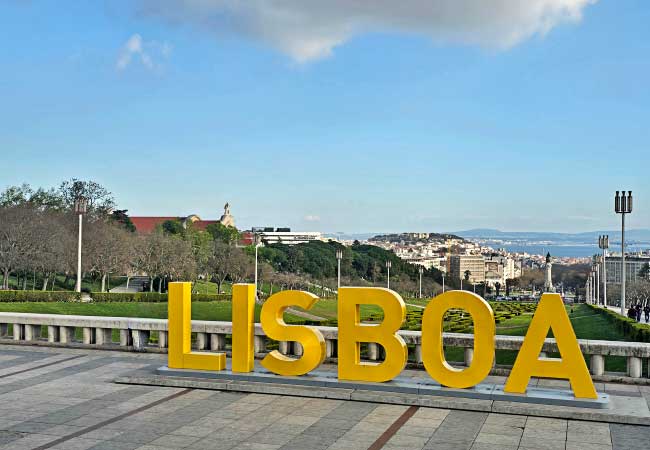
The “LISBOA" art installation at the Miradouro do Parque Eduardo
For the first few decades the park was functional but unremarkable. That changed in 1945 when the Portuguese modernist architect Francisco Keil do Amaral redesigned the park into the layout you see today: a central grass lane flanked by symmetrical box hedging, with mosaic-patterned walkways on either side and landscaped gardens running along the edges. It was Keil do Amaral's design that gave the park its distinctive geometric character and the long visual line that draws your eye from the hilltop down to the Marquês de Pombal and beyond to the river.
The park had already gained two of its most distinctive features before the redesign: the Estufa Fria greenhouse in 1933 and the Carlos Lopes Pavilion in 1932. Together they helped transform Parque Eduardo VII from a pleasant civic space into something with genuine character.
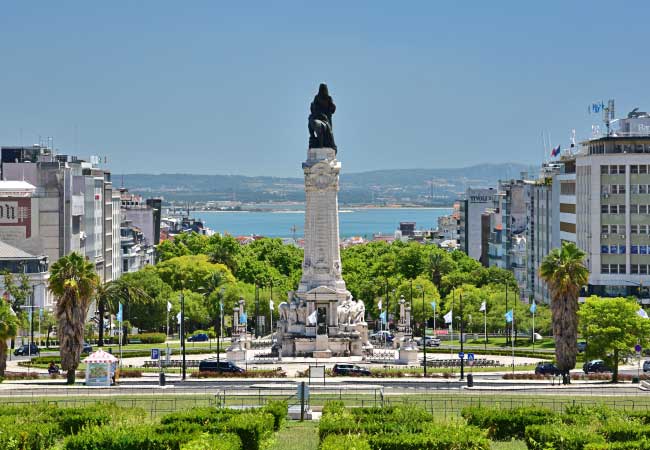
At the bottom of the Parque Eduardo VII is the Praça Marquês de Pombal, which would be a lovely plaza if it wasn’t chocked with traffic constantly
Estufa Fria (The Cold Greenhouse)
“If the viewpoint is the reason most people visit Parque Eduardo VII, the Estufa Fria is the reason they remember it” – having read this I fully agree.
I find the Estufa Fria a wonderful escape from Lisbon's hectic pace, traffic, and city pollution. It is a greenhouse complex built inside a former basalt quarry in the north-western corner of the park, and it is unlike anything else in Lisbon. The site comprises greenhouses and tropical gardens set around a natural spring, filled with palms, ferns, banana plants, and varied species from South America, Africa, and Asia.
Its history is as interesting as the plants concealed within it. The site began as a black basalt quarry, and if you have walked anywhere in Lisbon, you have walked on basalt. The dark stones that make up the black patterns in the city's famous calçada pavements were quarried from this site.
As the quarry grew and deepened during the late 19th century, a spring was exposed that regularly flooded the pit, making further mining impossible. The abandoned quarry sat unused until a local gardener began using it to shelter plants intended for the tree-lined Avenida da Liberdade nearby. The sheltered quarry walls and natural water supply turned out to be ideal growing conditions, and the plants thrived.
In the 1920s, the painter and architect Raul Carapinha recognised what the site could become and designed a proper greenhouse around it. The Estufa Fria opened to the public in 1933, and the key decision in its design was what not to do: rather than enclosing it in glass, Carapinha covered the quarry with a wooden lath roof. The slats filter sunlight and regulate temperature naturally, keeping the interior cool in summer and protected in winter. This is what gives the greenhouse its name: estufa fria means "cold greenhouse," because it uses no artificial heating at all.
The Estufa Fria itself is the largest and oldest section, covering around 8,100 square metres, and it is the one that makes the biggest impression. Tall tree ferns, palms, azaleas, and camellias grow beneath the slatted roof, with winding paths leading past small lakes, waterfalls, and scattered sculptures. You can still see the original quarry walls, now smothered in monstera and ferns. The plants come from across the world: China, Australia, Peru, Mexico, Brazil, and Korea among others. Look out for the Tasmanian tree ferns (Dicksonia antarctica), which are among the most striking specimens.
The Estufa Quente (Hot Greenhouse) was added in 1975 and is enclosed in glass to create genuinely tropical conditions. It is smaller, covering around 3,000 square metres, and houses coffee plants, mangifera, orchids, and other species that need consistent heat and humidity. The air inside hits you the moment you step through the door, thick and humid, a proper contrast to the drier Estufa Fria.
The Estufa Doce (Sweet Greenhouse), also added in 1975, is the smallest of the three and is dedicated to cacti, succulents, and aloe. It feels like a completely different climate from the other two sections and makes for an interesting contrast.
The site is tucked into the north-western corner of the park, in such a concealed and lowered position that it is easy to walk past without even knowing it's there. The entrance fee is €3.60 for adults, €2.33 for children and young people (6–18 years), €1.55 for seniors (65+/retired), and free for children under 6. Opening times are 10am–7pm (summer) and 9am–5pm (winter).
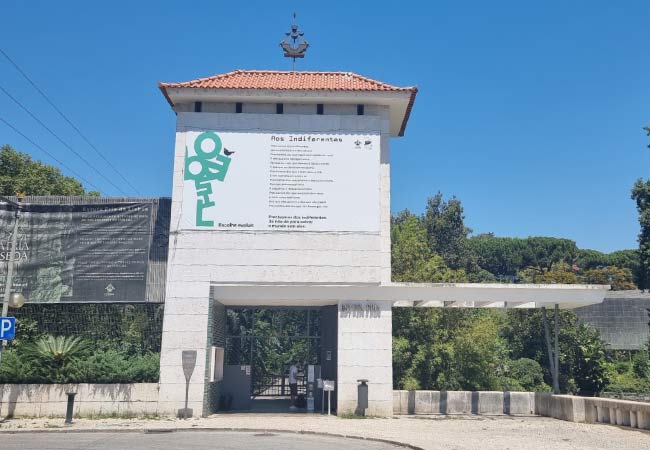
Miradouro do Parque Eduardo VII
The viewpoint at the top of Parque Eduardo VII is one of the best in Lisbon, but unlike many others, this is a sweeping view of the city, not one to spot famous sights. From here you get a straight, unbroken line of sight down through the park's geometric hedges, past the Marquês de Pombal statue, and all the way to the Tagus and the hills of the Serra da Arrábida on a clear day.
This is also where the city has installed one of its large yellow "LISBOA" signs, to encourage visitors to explore further out than the centre of Baixa.
Interestingly, the hill at the top of Parque Eduardo VII is not one of Lisbon's legendary seven. It is sometimes referred to as the Hill of São Sebastião, after the old quarry that once occupied the site.
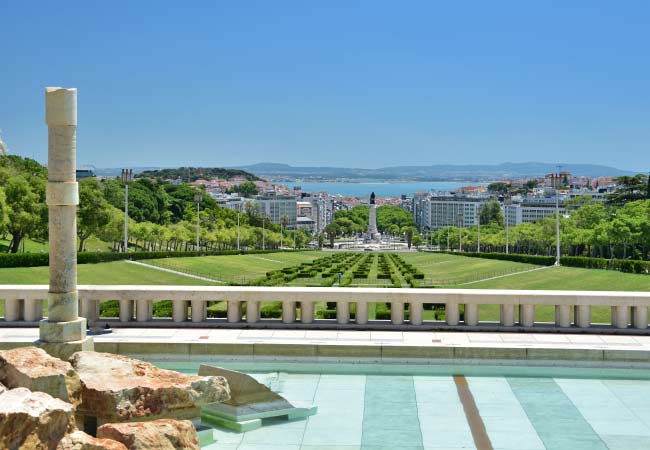
The Monumento ao 25 de Abril
Just behind the viewpoint, between two tall pillars, sits one of Lisbon's most debated pieces of public art. The Monumento ao 25 de Abril (Monument to the 25th of April) was designed by the sculptor João Cutileiro and inaugurated in 1997 to commemorate the Carnation Revolution of 1974, which ended decades of dictatorship in Portugal.
It is deliberately unlike any other monument in the city. Where most of Lisbon's memorials are smooth, figurative, and heroic, this one is raw and jagged. The rough-hewn stone is intended to represent the explosive force of the revolution and the breaking of the old regime. The central column caused considerable controversy when it was unveiled, with many residents and politicians finding its shape provocative. Cutileiro, who was known for pushing boundaries, maintained that the form symbolised the vitality and energy of the revolution.
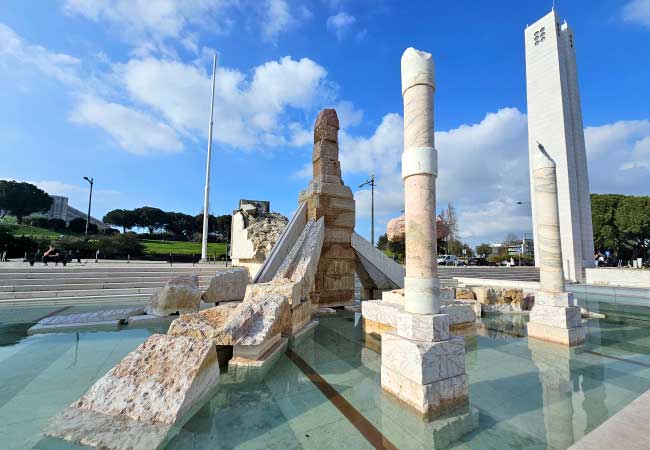
The monument sits in a shallow pool of water meant to evoke the Atlantic, and the stones appear to tumble into it, suggesting sudden, unstoppable change. The four columns, two towering at the back and two smaller at the front, are intended to represent the pillars of the new democracy being built. If you position yourself between them you can frame a view straight down through the Marquês de Pombal statue to the river, linking modern democratic Portugal with its historical past.
There is no heroic statue of a soldier or a leader here, and that is the point. The monument is about the event, not any single person. It is not to everyone's taste, and that seems to be exactly what Cutileiro intended.
The Carlos Lopes Pavilion
On the eastern side of the park, across from the greenhouses, stands one of the more unusual buildings in Lisbon, and one with a story that spans two continents.
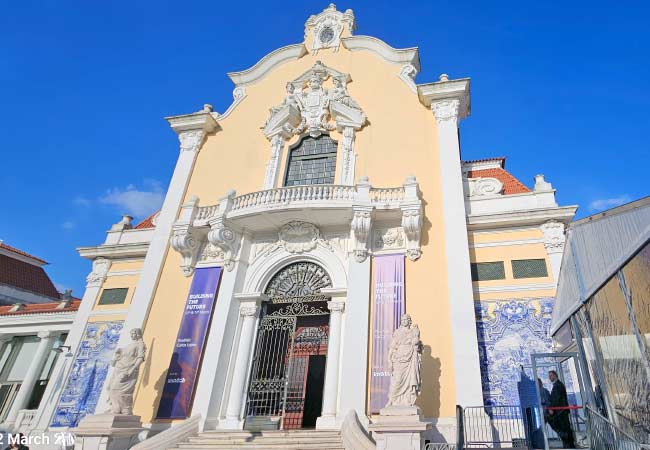
The pavilion was originally designed by Portuguese architects and built in Rio de Janeiro for the 1922 International Exposition, held to celebrate the centenary of Brazilian independence. When the exposition ended, the entire structure was dismantled, shipped across the Atlantic, and reconstructed here in Parque Eduardo VII. It reopened in 1932, just in time to host a Portuguese Industrial Exhibition, and has served as a venue for events, concerts, and even roller hockey championships in the decades since.
The building is named after Carlos Lopes, the Portuguese marathon runner who won the country's first ever Olympic gold medal at the 1984 Games in Los Angeles. From the outside, the white and ochre facade is handsome enough, but it is the azulejo tile panels that make it special. Created by the celebrated tile artist Jorge Colaço, they depict scenes from Portuguese history and cover large sections of the exterior walls. If you have already visited the São Bento Palace or the São Jorge Castle chapel, you may recognise Colaço's style. The panels here are among his finest work.
The pavilion fell into disrepair and was closed in 2003. For years it sat empty, which felt like a waste given the quality of the building. A full restoration was eventually completed and it reopened in 2017 as a modern events venue. You can walk up to admire the exterior and the tiles at any time, and it is worth the short detour from the central lawn.
Visiting the Parque Eduardo VII park
Parque Eduardo VII is open all day, every day, and entry to the park itself is free. The Estufa Fria greenhouses have their own hours and a small admission fee.
Getting there is straightforward. The park sits between two metro stations on the blue line. Marquês de Pombal is at the bottom of the park, right where the Avenida da Liberdade meets the roundabout. São Sebastião station is at the top, on the northern side, which is useful if you want to start at the viewpoint and walk downhill. If you are already in the city centre, walking up from the Baixa along the Avenida da Liberdade is the most pleasant approach, as the tree-lined boulevard is a sight in its own right and delivers you to the park's lower entrance naturally.
How long to spend depends on what you want to see. If you are here for the viewpoint and a stroll through the central lawn, 30 to 45 minutes is enough. Add the Estufa Fria and you should allow at least another hour, more if you enjoy botanical gardens and want to take your time. The Carlos Lopes Pavilion is a five-minute walk from the central path and takes only a few minutes to appreciate from the outside.
When to visit. The park works at any time of day, but the viewpoint is best in the late afternoon when the sun is behind you and the light falls warmly across the city below. For the Estufa Fria, midday on a hot day is ideal, as the temperature inside the greenhouse is a genuine relief. If you are visiting on a Sunday, arriving before 2pm gets you free entry to the greenhouses.
Combining with other sights. The park pairs naturally with a walk down the Avenida da Liberdade afterwards, which leads you back towards the Baixa and the Rossio. If you are planning a full day in this part of the city, the Calouste Gulbenkian Museum is a 10-minute walk north from the top of the park and is one of the best museums in Lisbon. The two complement each other well: the park for the air and the views, the Gulbenkian for one of Europe's finest private art collections.
Discover more of Lisbon with our most popular guides


About this guide: I'm Philip Giddings. I live in Graça with my Portuguese wife Carla, whose family are Lisboetas going back generations. I've been visiting Portugal since 2001, writing the independent guides at LisbonLisboaPortugal.com since 2009, and the site is now my full-time work. Carla first brought me up to Lisbon on an early trip, and twenty-five years on we are still walking the city together: summers on the packed beaches, quiet Saturdays at the Feira da Ladra, and hunting for a heater for our flat when the chilly winter arrives.
This site has 189 guides on Lisbon. It takes no payment from tourist boards, tour operators, or attractions for inclusion, and is funded by affiliate commissions on tour bookings, disclosed on every page that contains them. Every practical detail (ticket prices, opening hours, bus routes, time-slot policies) is checked against the official sources and verified in person on the walks I make through the city each week. Read the full story here.