LisbonLisboaPortugal.com
The best independent guide to Lisbon
LisbonLisboaPortugal.com
The best independent guide to Lisbon
Lisbon with children: is it the right city break for your family?
Most European capitals make parents choose. Adult sights or child-friendly distractions. History or playtime. Your holiday or theirs. In Lisbon you mostly don't have to pick a side.
A vintage yellow tram clattering up to the castle is a thrill ride. The maze of Alfama's alleys is an adventure with every turn. The cannons along the battlements of São Jorge are there to be climbed on. Here the city itself does a lot of the entertaining, which is why Lisbon is one of the few European capitals where a family holiday actually works for everyone.
That said, no city is the right fit for every family, and Lisbon is not the right fit for every age. It is hilly, hot in high summer, crowded in peak season, and demanding on parents of very young children in ways a resort holiday simply is not. I have hosted my brother and sister's children here many times, watched my wife's extended Lisbon family raise their own children through these streets, and helped countless friends plan their first family trip out. I will be honest with you about where the city works beautifully and where it will ask more of you than you might expect.
I have been visiting Lisbon for twenty-six years, and for the past five I have lived in the Graça district with my Portuguese wife. Every question answered in this guide was first asked by my own brother and sister before they brought their families out to stay. What follows is the honest answer to whether you should bring your children to Lisbon at all, an age-by-age view of what the trip will actually look like, the real challenges that other guides will not warn you about, and the practical answers to every question you will ask before you book.
The short answer
Lisbon works for families. It works well. The city is safe, walkable in its central districts, full of attractions designed with children in mind, and surrounded by some of the best urban beaches in Europe. Portuguese culture is openly affectionate towards children, and you will feel it from the first restaurant you walk into.
The catches are worth knowing before you book. Lisbon is built across seven hills, and the historic streets are cobbled, narrow, and often steep. Summer heat is intense from late June through August. Pushchairs are workable but harder than at home. Younger children will need a slower pace than you might be used to setting on a city break.
If your children are five or older, Lisbon is a strong choice. Under five, it is still possible, but you will need to plan for shorter days, longer breaks, and a base in the flatter Baixa district.

My 8 year old nephew and brother watching the central tank of the Oceanarium
What you will actually do in Lisbon with children
A note before we go further. This guide is not a list of attractions. If you have arrived here looking for what to see and do, you want my dedicated guide to child-friendly activities in Lisbon, which covers each sight in detail with ages, prices, opening hours, and how to reach them.
What this section gives you is the shape of a typical family trip, so you can picture what your days will actually look like.
A first-time family visit to Lisbon almost always includes the Oceanário, which sits in the modern Parque das Nações district and is one of the best aquariums in Europe. My nephew first went in 2020, when he was four, and we have been back with him every year since. He is ten now and still asks to go. Few attractions hold a child's attention for six years running, and that one has.
You will ride the number 28 tram, climb to the Castelo de São Jorge, and lose an afternoon in the alleys of Alfama. Older children take to the Quake earthquake museum, which is one of the better-designed family attractions I have seen anywhere in Europe. Younger ones prefer the Pavilhão do Conhecimento, the city's interactive science museum, which is where my younger nieces, now seven and three, have spent hours on their last few visits.
Beyond the city, the beaches at Cascais and Carcavelos are a forty-minute train ride away, and Sintra is close enough for a day trip if your children are old enough to walk a hilly palace garden. Most families I help plan trips for end up doing two or three days in Lisbon itself, one beach day, and a day in Sintra across a week.
For the full breakdown of attractions, ages, costs, and which ones earn the entry fee, head to my Lisbon with children: best sights and activities guide. The rest of this article focuses on the questions that come before that one, which is whether Lisbon is the right city for your family in the first place.
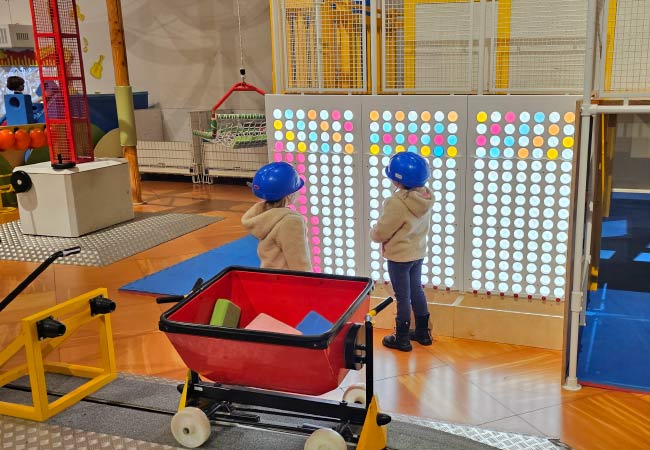
My two nieces playing construction in the Pavilhão do Conhecimento
Why Lisbon works for families
Portuguese culture welcomes children in a way that catches many visitors off guard. Here, children aren't just put up with, they're folded into everything. You will see this within an hour of arriving.
Walk into any neighbourhood restaurant at eight in the evening and you will find tables of three generations eating together, a toddler asleep on a banquette and an eight-year-old chasing her cousin between the tables. The waiter will bring crayons without being asked. The owner will come over to greet your children before greeting you. My wife's extended family in Lisbon has been quietly demonstrating this to me for twenty years, taking my visiting nieces and nephews on weekend outings, feeding them at long Sunday lunches, scolding them as their own. It is the cultural backdrop to the trip, and it changes how a family holiday feels.
The restaurants themselves often go further than you expect. We took my nephew to Buga Ramen near Rossio, and he is still talking about it three years later. Anime and Japanese comic art covering every wall, a robot trundling between the tables to deliver the food, and a Japanese front-of-house team who fussed over him from the moment we sat down. He had never been anywhere like it. Lisbon's restaurant scene delivers experiences like this without treating them as something special.
The practical layer matches the cultural one. Everyone in tourism speaks good English. Pharmacies are everywhere, often two or three to a street. Supermarkets stock all the familiar brands of nappies, formula, and baby food, so you do not need to pack a fortnight of supplies. Hotels and apartments expect children. Taxis and Ubers are cheap and plentiful, which matters at the end of a long day when small legs have stopped working.
The city itself does much of the entertaining for you. The trams, the castle, the riverside, the lifts and funiculars climbing between the levels of the city. None of it was built to amuse children, and yet a four-year-old treats the whole thing as a theme park. My brother's two, who first came out at three and one and have come back every year since, still treat a tram ride as the headline event of any visit. They are ten and eight. The novelty has not worn off.
There is also the matter of what sits an hour from the city. The Cascais coastline is a string of family beaches with soft sand, calm water, and lifeguards in summer. Sintra is a forested hillside of fairytale palaces. The Arrábida peninsula to the south is wilder and emptier than anything you would expect this close to a capital. Lisbon makes a fine city break on its own, but as a base for a week of varied family days it's better still, and that's where it pulls ahead of most European capitals.
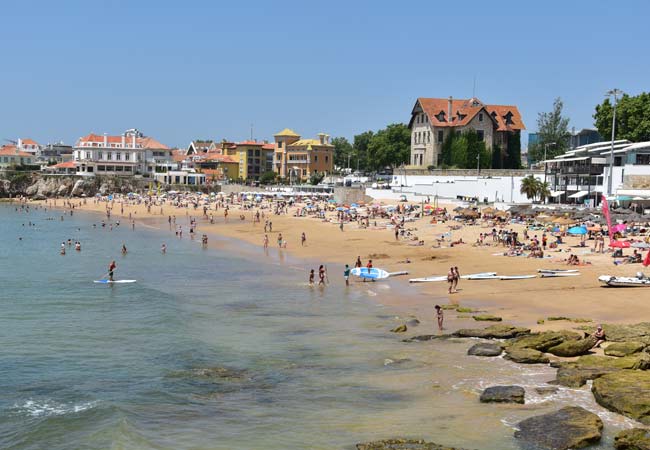
The family-friendly beaches at Cascais only 30 minutes away by train
The honest challenges
For all the warmth of the welcome, Lisbon will ask more of you than a flat northern European capital. Five things in particular catch families out, and you should know about them before you book.
The hills will catch you out. Lisbon is built across seven of them, and the historic centre runs up and down all of them. A morning at the castle is not a casual stroll. It is a forty-minute climb on cobbles. Routes that look short on the map are anything but, because the map does not show the gradient. My sister, who has been out four times now with my two younger nieces, learned this on her first trip. They walked from Rossio up to the castle in August with the three-year-old in a pushchair, and by the top everyone was crying, including the adults. From her second trip we based any journey around Uber (and Uber XL to fit us all in). The whole holiday changed.
The cobbles are more of a trial than anyone warns you about. Lisbon's pavements are not just decorative. They are the famous calçada portuguesa, hand-laid limestone setts that are uneven, polished smooth by centuries of feet, and treacherously slippery in the rain. Pushchairs work, but they rattle and snag. Small children fall over more often than they do at home. Bring shoes with grip, and accept that you will move more slowly than you planned. My wife has gone over more than once in sandals, never on the way up, always on the way down.
Summer is hot, and not the kind of hot most families are used to. From late June into early September, daytime temperatures sit between 28 and 35 degrees, with the inland streets feeling ten degrees hotter than the riverfront. It is dry heat, which sounds easier than it is. Children dehydrate quickly, burn within minutes, and lose their appetite by lunchtime. If you are coming in July or August, you will need to restructure the day. Out early, back to the apartment by midday, out again at five.
Peak season crowds are punishing. Lisbon has become one of Europe's most visited capitals over the past decade, and the historic core feels it. The number 28 tram is almost impossible to board in summer. The queue for the oceanarium ticket office can run for an hour at midday. Alfama in August is a slow shuffle from one bottleneck to the next. Families who have done other European cities at peak will recognise the pattern. Families who have not will find it overwhelming with small children in tow.
Bedtimes are the one thing that splits families. Portuguese children stay up late. Restaurants will serve you with a four-year-old at half past nine and think nothing of it. This is wonderful if your children travel well and adapt. It is harder if your routine depends on a seven-o'clock bedtime. The workaround my sister found best for her was to eat lunch as your main meal and keep dinner light back at the apartment.
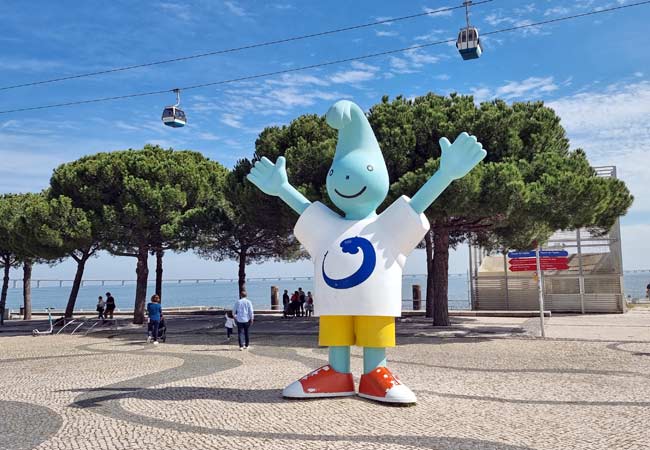
The Parque das Nações
Is a city break really right for your family?
There is a question worth sitting with before you book, and it is not the one most parents ask themselves. The better question isn't whether the children will enjoy Lisbon, it's whether a city break is the kind of holiday they actually need right now.
I see this pattern every year. Parents who love city breaks plan a city break, bring their small children along, and spend a week dragging tired three-year-olds up cobbled hills in the heat. The children are miserable, the parents are exhausted, and everyone comes home needing a second holiday to recover from the first.
If your children are under four, the honest answer is often that a beach holiday will serve your family better. A villa with a pool, a stretch of soft sand, a routine that holds together, and enough downtime for everyone to catch up on sleep. That is what very small children need from a week away, and the Algarve, the western Algarve in particular, gives it to them in a way Lisbon never quite can.
A city break is not a passive holiday. It is a sequence of long days on your feet, broken routines, late dinners, busy streets, and constant decisions about what to do next. Older children rise to that. Younger children buckle under it, and the parents end up carrying both the buckling child and the holiday itself on their shoulders.
This is not me telling you not to come. It is me asking you to be honest about what your children need from the week away. If they are five or older, Lisbon is one of the best European city breaks you can give them. If they are very young, ask yourself whether something quieter would do more for everyone, you included.
A useful test, if you are unsure. Picture the same holiday with your children seven years older. If that picture is markedly better than the one you are about to book, your children may be too young for what you are planning. Wait. Come back when they are ready. Lisbon will still be here.
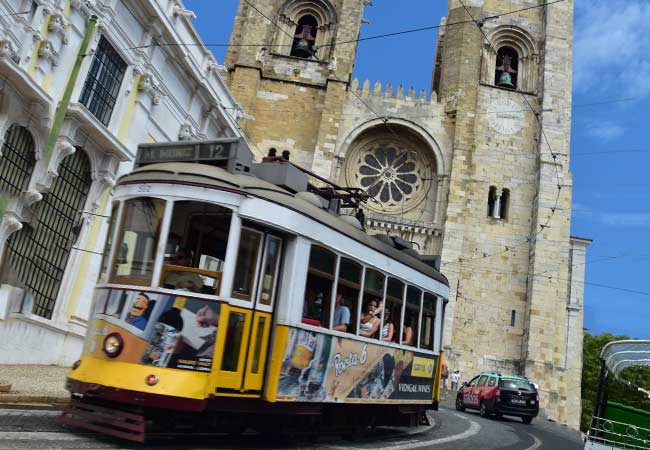
The number 28 tram as it passes the cathedral
Is Lisbon right for your family? An age-by-age view
Most family guides treat children as a single category. They are not, and the answer to whether Lisbon suits your family depends almost entirely on the ages of the children you are bringing. Here is how each stage tends to play out, drawn from years of watching my own family work through them.
Babies and toddlers (0 to 2). Lisbon is possible at this age, but it is the hardest stretch. The cobbles will defeat any pushchair that is not built for rough ground. The hills mean you will be pushing uphill several times a day. Summer heat is not safe for sustained outdoor time with a baby. The advantages are real, however. Portuguese strangers will engage with your baby in a way that British families often find startling at first and then very welcome. Restaurants will accommodate you at any hour. If you come at this age, come in April, May, or October, bring a baby carrier alongside or instead of the pushchair, and base yourself somewhere flat. My sister brought her youngest at eighteen months in July, and it was, by her own account, the hardest holiday she has taken. The same child at three was a completely different proposition.
Preschoolers (3 to 5). This is where Lisbon starts to come into its own. Children at this age have the stamina for short sightseeing mornings and the imagination to be enchanted by trams, castles, and an aquarium full of sharks. They are still in pushchairs some of the time, which keeps the hills manageable. You will not get full days out of them, but two or three highlights spread across a morning, a long lunch, and a quieter afternoon works beautifully. My younger niece, now three, has been to the Oceanário on every visit and treats the otters as personal acquaintances.
Primary school age (6 to 10). If I could choose an age for a first family trip to Lisbon, it would be this one. Children at this stage walk the distances without complaint, engage with the culture, ask sharp questions at the Quake museum, and have the patience for a proper restaurant meal. My nephew has been out every year since he was four, and the visits at eight, nine, and ten have been the most enjoyable for everyone. The city opens up at this age in a way it does not for younger or older children. Sintra becomes a full day rather than a forced march, the beach days are a highlight rather than a struggle, and this is the trip they'll still talk about years later.
Tweens and teenagers (11 and up). Lisbon at this age is essentially an adult trip with a few practical adjustments. Older children engage with the food, the history, the architecture, and the design of the city in ways that surprise their parents. Surf lessons at Cascais and Carcavelos are popular at this age. The Sintra palaces become serious sightseeing rather than fairytale outings. The one shift is the evening rhythm. Portuguese teenagers stay out late, restaurants are busy from nine, and the city is still alive at eleven. Most families with older teenagers find this an upgrade rather than a problem.
Safety and security: a city, not a resort
Lisbon is one of the safest capitals in Europe. Violent crime against tourists is rare. You can walk most of the central districts at night, and Portuguese strangers are more likely to help you than to bother you. By European-capital standards, this is a low-stress city.
That is the headline. The footnote is that Lisbon is still a major city, and you cannot switch off with children in the way you can at a resort. The risks are not the dramatic ones that make the news. They are the everyday ones that catch tired parents off guard.
Pickpockets are the most common problem. The number 28 tram, and the busy stretches of Baixa and Alfama are all worked by organised pickpockets, particularly in summer. They are quick, calm, and very good at what they do. Keep wallets and phones in front pockets or zipped bags, and never leave anything in a backpack worn on your back in a crowd. You will not feel it happen.
The traffic is worse than you expect. Lisbon drivers do not stop for pedestrians. Zebra crossings are advisory at best. Mopeds and electric scooters weave through pedestrians at speed, often on the pavement itself. Children who are used to crossing roads at home will misjudge it here. Hold hands at every crossing, every time. This is the single most important safety habit on a Lisbon family holiday.
Late-evening fringes can be uncomfortable. Around Cais do Sodré after dark, Martim Moniz and parts of Barrio Alto, after midnight, you may encounter drunk groups, drug dealers offering their wares, and occasional unstable people. Nothing dramatic, but not the atmosphere you want children walking through at ten in the evening. Stick to the well-lit main streets, and use taxis or Ubers for the journey back to your hotel rather than walking through quieter areas.
None of this means Lisbon is dangerous, because it really isn't, but a city holiday with children is a fundamentally different exercise from a resort one. There is no fenced pool area, no all-inclusive bracelet, no gated grounds. You are in a working European capital, and parental attention has to stay switched on, all day, every day. Families who understand this from the start enjoy Lisbon enormously. Families who expect a city to behave like a resort find it stressful.
The practical questions parents ask
A handful of practical points come up from families before they travel. Here are the short answers, with links to my dedicated guides where there is more depth to go into.
When should we come?
The best months for a family trip are May, early June, late September, and October. Warm enough for the beach, cool enough for sightseeing, and the crowds are manageable. The catch is that none of these months align with most school holidays. Easter is the obvious compromise, and it is when my brother brings his family out almost every year. Book early, because every Portuguese family with children does the same.
If you can only travel in July or August, you can still have a wonderful time, but you will need to restructure the day as I described earlier. Winters are wet but mild, with temperatures rarely below 14 degrees, and December can be an excellent time to come with older children who do not need the beach. For a fuller breakdown by month, see my guide to the best time to visit Lisbon.
Where should we stay?
For a first family trip, base yourselves in Baixa or along the Avenida da Liberdade. Both are central, both are flat (a rarity in Lisbon), and both put you within walking distance of restaurants, metro stations, and the trams that climb to the more historic districts. This is where my brother stays on every visit, and where I send most of the families I help plan trips for.
Three popular areas are not well-suited to families. Alfama is beautiful but too hilly and too cobbled with small children. Bairro Alto and Cais do Sodré are the city's nightlife districts and noisy until three or four in the morning. Belém is lovely to visit but too far from the centre to be a good base. I live in Graça, which I love, but I would not send a family with young children to stay there. For the full breakdown of neighbourhoods, see my where to stay in Lisbon guide.
How do we get in from the airport?
Lisbon airport sits inside the city limits, only seven kilometres from the centre. I collect family from this airport four or five times a year, and when I meet them I always call an Uber or a Bolt to take us to their accommodation. Taxis from the airport rank have a long-standing and well-deserved reputation for trying to scam tired visitors with inflated fares or detours, and there is nothing worse than starting a holiday arguing with a driver. Uber and Bolt give you a fixed price up front, a map of the route on your phone, and no negotiation. A typical fare to Baixa is around fifteen euros, and the journey takes twenty minutes outside rush hour.
The metro is cheaper at one euro fifty per person, but it involves a change at Alameda, stairs at several stations, and a walk at the other end. It is not worth it with tired children at the end of a flight. The full breakdown is in my airport travel guide.
Should we hire a car?
For a Lisbon-only trip, no. I have driven in Lisbon many times, and I would not put a visiting family through it, especially if you are based near the historic centre. The streets are narrow, the drivers are erratic, the one-way systems are unforgiving, and parking is scarce and expensive. You will be walking or using the metro for ninety per cent of the trip anyway.
A rental car becomes worth considering only if you are planning serious day trips to the Alentejo, the Arrábida coast, or further afield, and even then I would suggest hiring it on the day you collect it rather than keeping it parked in the city. Uber and Bolt cost less than you might expect within Lisbon and remove every headache.
Is the food safe?
Yes, without qualification. Food standards in Portugal are high, restaurants are well-regulated, and the risk of food-related illness is no greater than it is at home. My nieces and nephews have been eating in Lisbon since they were weaning, and we have never had a problem. Twenty years of long Portuguese family lunches and not one stomach upset between us.
Is the tap water safe to drink?
The water supply in Lisbon is safe, and tap water in any cafe or restaurant is fine to drink. The complication is the pipework in older buildings, which can be old enough to leave the water tasting metallic or stale. In a hotel room or apartment in one of the historic districts, I would stick to bottled water for drinking and brushing teeth. In a cafe, just ask for a copo de água and it will arrive free.
Discover more of Lisbon with our most popular guides


About this guide: I'm Philip Giddings. I live in Graça with my Portuguese wife Carla, whose family are Lisboetas going back generations. I've been visiting Portugal since 2001, writing the independent guides at LisbonLisboaPortugal.com since 2009, and the site is now my full-time work. Carla first brought me up to Lisbon on an early trip, and twenty-five years on we are still walking the city together: summers on the packed beaches, quiet Saturdays at the Feira da Ladra, and hunting for a heater for our flat when the chilly winter arrives.
This site has 189 guides on Lisbon. It takes no payment from tourist boards, tour operators, or attractions for inclusion, and is funded by affiliate commissions on tour bookings, disclosed on every page that contains them. Every practical detail (ticket prices, opening hours, bus routes, time-slot policies) is checked against the official sources and verified in person on the walks I make through the city each week. Read the full story here.