LisbonLisboaPortugal.com
The best independent guide to Lisbon
LisbonLisboaPortugal.com
The best independent guide to Lisbon
Igreja de Santo António Church, Lisbon; An Independent Tourism Guide for 2026
In the shadow of Lisbon's mighty Cathedral, a modest church holds an extraordinary secret. The Igreja de Santo António marks the exact spot where, in 1195, Fernando de Bulhões was born, the man the world would come to know as Saint Anthony of Padua. While his tomb in Italy draws millions of pilgrims, this birthplace shrine tells a different story: Lisbon's fierce, unbreakable claim to its most beloved son.
This is not merely a church built in honour of a saint. It stands on the very foundations of his childhood home, where the future miracle-worker took his first breath. The crypt beneath the altar preserves the sacred ground where his cradle once stood, validated by papal pilgrimage when Pope John Paul II descended to pray in this humble space in 1982.
But the Igreja de Santo António is more than a birthplace shrine, it's the beating heart of Lisbon's identity. On June 13th each year, the entire city erupts in celebration for their adopted patron saint, transforming the church into the epicentre of the Festas Populares. The building itself tells a remarkable story of resilience: devastated by the Great Earthquake of 1755, it was rebuilt not by royal decree but penny by penny through children's collections, making it truly the people's church.
Today, visitors can witness both the miraculous pre-earthquake chapel that survived the disaster and discover unexpected treasures, including the hidden full-body relics of a 1st-century Roman martyr.
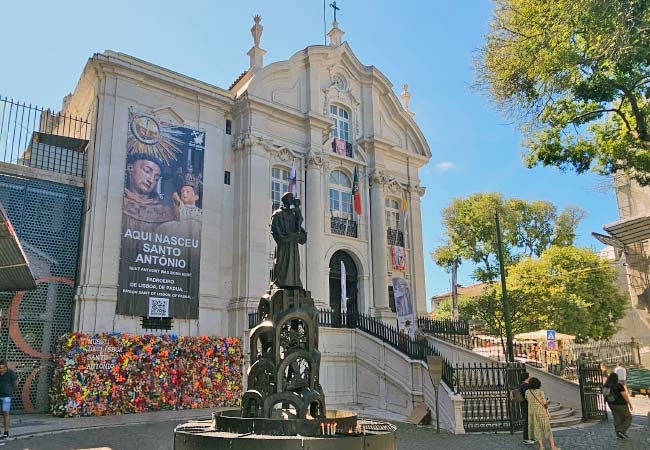
The charming Igreja Santo Antonio Lisbon and statue of Saint Anthony
Highlights of Igreja de Santo António
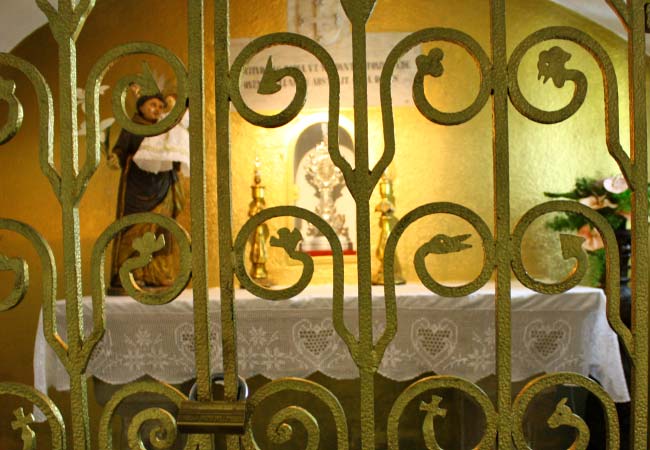
The Sacred Crypt: Descend to the exact birthplace of Saint Anthony, the humble stone space where Fernando de Bulhões was born in 1195. This authentic site was sanctified by Pope John Paul II's personal visit and prayer in 1982.
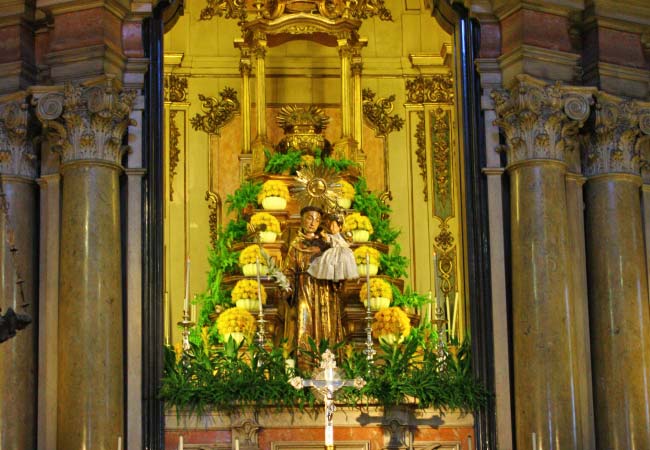
The Miraculous Capela-Mor: Marvel at the main altar that miraculously survived the devastating 1755 earthquake. This pre-disaster Baroque masterpiece, with its "miraculous" statue of Saint Anthony, became the foundation myth for the church's resurrection.
Saint Justina's Hidden Relics: Discover one of Lisbon's best-kept secrets – the complete body of a 1st-century Christian martyr, gifted by Pope Pius VI in 1777, housed in an exquisite reliquary altar where devotees still slip handwritten prayers.
The Matchmaker's Statue: Try your luck at love with the famous Saint Anthony statue outside. Tradition holds that successfully landing a coin in the saint's book will grant your romantic wishes, a beloved ritual for locals and visitors alike.
The Museum of Saint Anthony: Explore the adjacent museum's remarkable collection spanning from medieval manuscripts to folk art, revealing eight centuries of unbroken devotion to Lisbon's favourite son.
Tourist Information for Igreja de Santo António
The church is open daily with visiting hours: weekdays from 8:00 AM to 7:00 PM, and weekends and feast days from 8:00 AM to 7:45 PM. Entry to the church itself is completely free, making it an essential stop for budget-conscious visitors.
The Museum of Saint Anthony operates Tuesday through Sunday from 10:00 AM to 6:00 PM (last entry at 5:30 PM) and remains closed on Mondays, January 1st, May 1st, and December 25th. Museum admission costs €3 for a single ticket.
Located at Largo de Santo António da Sé, the church sits just steps from the Lisbon Cathedral in the historic Alfama district. The nearest metro station is Terreiro do Paço (Blue Line), approximately 10 minutes' walk uphill. The iconic Tram 28 stops at Sé (Cathedral), placing you within sight of the church.
A typical visit lasts 10-20 minutes for the church and crypt, with an additional 30minutes recommended for the museum. The site is partially accessible, with the main church floor accessible to wheelchairs, though the crypt requires descending stairs.
A Brief History of Igreja de Santo António
1195: Fernando de Bulhões is born in a noble family home on this site, near the Lisbon Cathedral
1220: Young Fernando joins the Franciscan Order, taking the name António after hearing of martyred missionaries
1231: Anthony dies in Padua at age 36; his extraordinary popularity spreads rapidly across Europe
1232: Canonized by Pope Gregory IX less than one year after death, one of the fastest canonizations in history
15th Century: The birthplace home is converted into a small chapel honouring the local saint
Early 1500s: King Manuel I orders the first significant church construction on the site
1730: King João V commissions a grand Baroque renovation in the opulent style of his era
1755: The Great Lisbon Earthquake destroys the church, except for the miraculous survival of the main chapel
1767: Reconstruction begins under architect Mateus Vicente de Oliveira, funded by children's street collections
1812: The new church is completed, blending Pombaline rationalism with surviving Baroque elements
1982: Pope John Paul II visits and prays in the birthplace crypt, confirming its global significance
1998: The Museum of Saint Anthony opens, presenting the saint's story as integral to Lisbon's identity
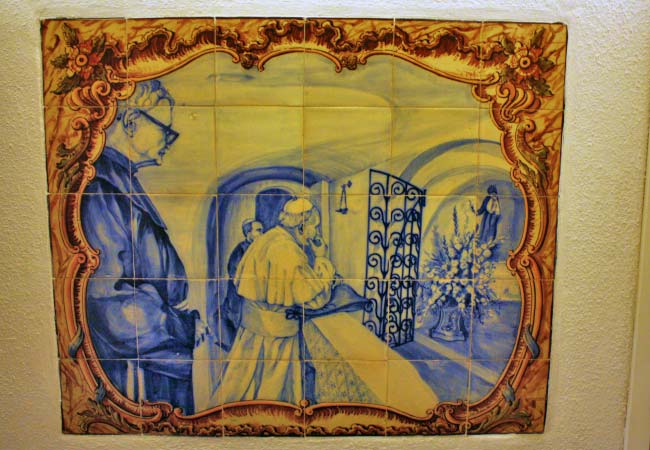
A tile painting commemorating the Pope’s visite to the church
The Matchmaker's Statue: A Game of Love and Luck
Standing guard outside the church, the statue of Saint Anthony has become one of Lisbon's most entertaining romantic traditions. The saint holds an open book in his hands, and the challenge is simple yet tantalizing: toss a coin and try to land it in the pages. Success, according to local legend, guarantees that Saint Anthony will intervene in your romantic life within the year.
The tradition draws from Anthony's centuries-old reputation as the patron saint of matchmakers and lost things, including lost hearts. Portuguese grandmothers have long prayed to Santo António when their grandchildren remained stubbornly single, and young women traditionally placed statues of the saint upside down in drawers, only setting him upright once they found a husband. This coin-tossing ritual is simply the latest evolution of these folk traditions, transforming ancient devotion into an interactive experience.
For best results, locals insist you should make your wish before throwing, use a coin from your home country (foreign currency apparently gets Anthony's attention), and most importantly, if you succeed on your first try, you must return to thank the saint once your wish is granted. Some visitors return multiple times, convinced that persistence will eventually win the saint's favour!
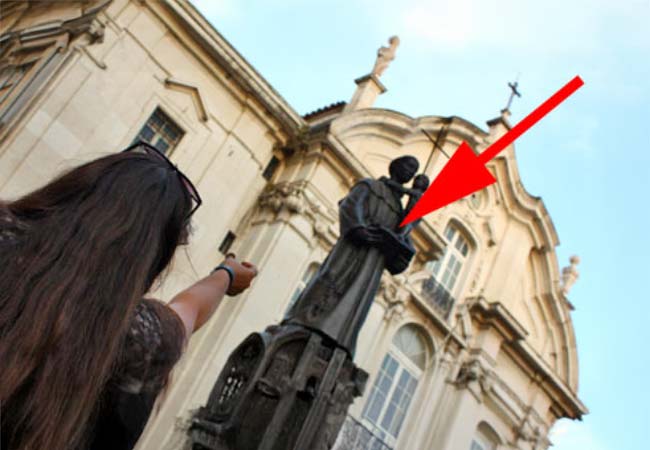
Looking for love? - get a coin in the book (where the red arrow is!)
The Miracle of 1755: A Church Reborn from Disaster
On All Saints' Day, November 1st, 1755, Lisbon experienced one of history's most devastating earthquakes. The magnificent Baroque church of Santo António, recently adorned by King João V's lavish patronage, collapsed into ruins within minutes.
When the dust settled and survivors began to search the wreckage of the church, they discovered that main chapel (Capela-Mor) remained standing amid complete devastation. More remarkably still, the precious statue of Saint Anthony at its center had survived unscathed. In a city grasping for meaning after incomprehensible loss, this "miracle" became a powerful symbol of divine protection and hope.
The reconstruction that followed was unlike any other building project in post-earthquake Lisbon. Rather than royal treasury funds that rebuilt palaces and government buildings, the new Igreja de Santo António rose through an unprecedented grassroots campaign. Children became the project's fundraisers, approaching citizens with the plea "um tostãozinho para o Santo António" (a small coin for Saint Anthony). This penny-by-penny collection created something unique, not a monument to royal power, but a church that literally belonged to the people.
The architect Mateus Vicente de Oliveira, a key figure in Lisbon's Pombaline reconstruction, faced an unusual challenge. He had to build a modern, earthquake-resistant structure around the sacred pre-1755 chapel that had miraculously survived. The result is architecturally fascinating: a rational, Neoclassical exterior embracing a Baroque jewel box within. Visitors today can literally see this timeline in stone, the austere 1760s nave leading to the opulent 1730s altar, with the transition marking the exact boundary between destruction and miracle.
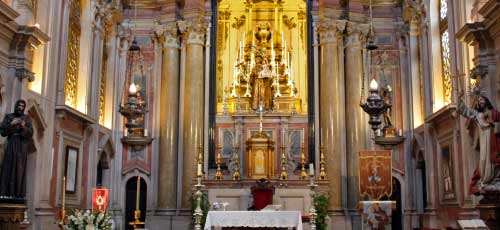
The alter of the Saint Anthony church
Detailed Guide to the Church Interior
The Sacred Crypt (Cripta)
Descending the narrow stairs to the crypt is like traveling back through eight centuries. This simple, vaulted space preserves the exact spot where, according to unwavering tradition, Fernando de Bulhões was born in 1195. The contrast with the ornate church above is intentional and powerful, this is not a space for golden altars or painted ceilings, but for intimate communion with history.
The walls are bare stone, part of the original 12th-century foundations of the Bulhões family home. The simplicity serves a purpose: nothing distracts from the profound significance of standing where Saint Anthony's story began. A modest altar marks the traditional site of his birth, while modern azulejo panels, added after 1982, commemorate Pope John Paul II's pilgrimage to this exact spot. When the Pope knelt here in prayer, he provided the ultimate validation of the site's authenticity, acknowledging what Lisboetas had never doubted.
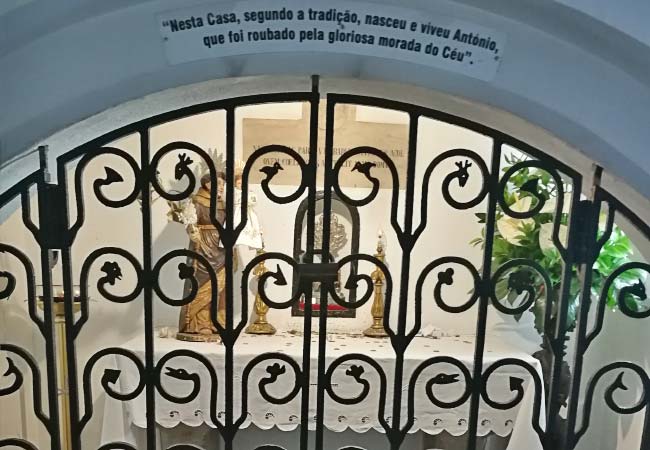
"In this House, according to tradition, António was born and lived, who was stolen for the glorious dwelling of Heaven"
The Capela-Mor (Main Chapel)
This is the miraculous survivor of 1755, the only part of King João V's church to withstand earthquake, fire, and tsunami. The altarpiece is a masterwork of Portuguese Baroque, featuring spiral columns that seem to ascend toward heaven, supporting a magnificent throne beneath an ornate baldachin. Every surface gleams with talha dourada (gilded woodcarving), creating an effect of supernatural radiance when caught by candlelight.
At its center stands the star of this golden theatre: the polychrome wooden statue of Saint Anthony that survived the earthquake. Carved with extraordinary delicacy, the saint holds the Christ child while standing on a silver pedestal, his painted features still vivid after nearly three centuries.
Flanking Anthony are two significant companions: São Vicente, Lisbon's official patron, diplomatically included but clearly in a supporting role, and São Sebastião, invoked against plague and disaster. The arrangement speaks volumes about hierarchies both official and emotional in Lisbon's spiritual landscape.
The Museum of Saint Anthony
Adjacent to the church, occupying buildings on the saint's birth site, the Museum of Saint Anthony opened in 1998 as a branch of the Museum of Lisbon. This institutional choice was deliberate – the museum presents Anthony not merely as a religious figure but as fundamental to understanding Lisbon's civic identity.
The permanent exhibition navigates brilliantly between hagiography and anthropology. Yes, there are medieval manuscripts and Renaissance paintings depicting miracles – Anthony preaching to fish, levitating during prayer, appearing simultaneously in two places. But equal attention is given to how ordinary Lisboetas have expressed their devotion across centuries: hand-carved folk statues, elaborate miniature "thrones" built for neighbourhood festivals, ex-votos left in gratitude for answered prayers.
The museum's greatest strength is contextualizing the Festas Populares. Visitors can examine historical examples of the famous "Saint Anthony's throne", elaborate neighbourhood shrines that compete for prizes each June. A 17th-century piece known as "Toni Malau" (Bad Tony or Lucky Anthony) reveals how folk tradition has always walked alongside official church doctrine, creating a saint who is simultaneously miracle-worker and neighbourhood friend.
The collection includes significant artworks beyond religious pieces. The bequest from 20th-century sculptor Leopoldo de Almeida and baroque pieces by Joaquim Machado de Castro demonstrate how Anthony has inspired Portuguese artists across every era.
The People's Saint: Why Santo António Owns Lisbon's Heart
Lisbon harbours an open secret that reveals everything about its character: Santo António is not technically the city's patron saint. That honour officially belongs to São Vicente (Saint Vincent). Yet on any June evening, when the narrow streets fill with music and the scent of grilled sardines, when couples exchange poems over candlelit tables and children parade with handmade lanterns, it becomes clear who truly rules Lisbon's heart.
The reason is delightfully pragmatic. Saint Vincent's feast day falls on January 22nd, hardly ideal weather for the outdoor celebrations that define Lisbon's soul. Saint Anthony's day, June 13th, arrives at the perfect moment for street parties, romantic encounters, and all-night festivities. The city essentially "adopted" Anthony by popular demand, choosing celebration over ceremony, joy over protocol.
This democratic choice mirrors the church's own history. When royal funding might have rebuilt a grander monument after 1755, it was instead the copper coins of children that raised these walls. Every stone represents a small sacrifice from an ordinary family, creating a unique social contract. This is why, during the Festas Populares, the church doesn't feel like a monument being visited but rather like a family home throwing open its doors.
The tradition of the "Saint Anthony's Weddings" (Casamentos de Santo António) perfectly captures this spirit. Each June 13th, the city sponsors the weddings of local couples who might not otherwise afford elaborate ceremonies. They process to the church for blessings before leading that night's parade through the Alfama. It's a tradition that would seem out of place in a royal chapel but feels perfectly natural in a church built by the community, for the community.
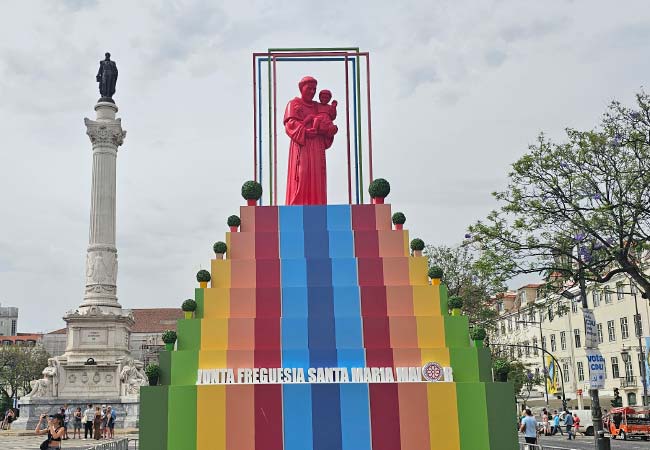
Discover more of Lisbon with our most popular guides


About this guide: I'm Philip Giddings. I live in Graça with my Portuguese wife Carla, whose family are Lisboetas going back generations. I've been visiting Portugal since 2001, writing the independent guides at LisbonLisboaPortugal.com since 2009, and the site is now my full-time work. Carla first brought me up to Lisbon on an early trip, and twenty-five years on we are still walking the city together: summers on the packed beaches, quiet Saturdays at the Feira da Ladra, and hunting for a heater for our flat when the chilly winter arrives.
This site has 189 guides on Lisbon. It takes no payment from tourist boards, tour operators, or attractions for inclusion, and is funded by affiliate commissions on tour bookings, disclosed on every page that contains them. Every practical detail (ticket prices, opening hours, bus routes, time-slot policies) is checked against the official sources and verified in person on the walks I make through the city each week. Read the full story here.
 -
-
If you've found our content valuable, we'd welcome your support.
The digital publishing landscape has evolved significantly. As a small independent publisher, we face growing challenges. Search engines increasingly favour paid content over organic results, while AI-generated content often reproduces original work without attribution.
To support our work, please consider bookmarking this page (press Ctrl + D) for quick access. If you find an article helpful, we'd be grateful if you'd share it with friends on social media.
For specific questions, please see our Reddit community at r/LisbonPortugalTravel.
Should you notice any outdated or incorrect information, please contact us at [email protected]
Thank you for helping us continue to provide valuable content in an increasingly challenging digital environment.