LisbonLisboaPortugal.com
The best independent guide to Lisbon
LisbonLisboaPortugal.com
The best independent guide to Lisbon
Lisbon to Cristo Rei (Christ Statue) by ferry and bus in 2026
Cristo Rei stands on the far bank of the Tejo, directly across the water from central Lisbon. You can see it from almost everywhere in the city, yet reaching it takes a little more thought than most people expect. There is no direct bus from Lisbon, and driving means crossing the Ponte 25 de Abril, which becomes a serious bottleneck at the toll during rush hour. The route I recommend, and the one I have used for twenty-five years, is the ferry from Cais do Sodré to Cacilhas, followed by the 3001 bus up the hill. The whole journey takes under an hour, and the return costs less than €5.
For the majority of visitors, the ferry and bus is the right answer, and not only on price. It turns the inconvenience of the journey into part of the day's experience. The ferry is a short crossing of the estuary, passing close beneath the suspension bridge, and it lands you in Cacilhas, a working waterfront town with some of the best-value seafood near Lisbon.
This guide covers every stage of the trip in detail: the ferry fares and timetables, where to catch the 3001 bus, the alternative of Uber, and the quickest way to return to Lisbon afterwards. By the end you will know exactly which option suits you and how to get the most from the trip.
Related articles: Lisbon day trips - guide to Cacilhas
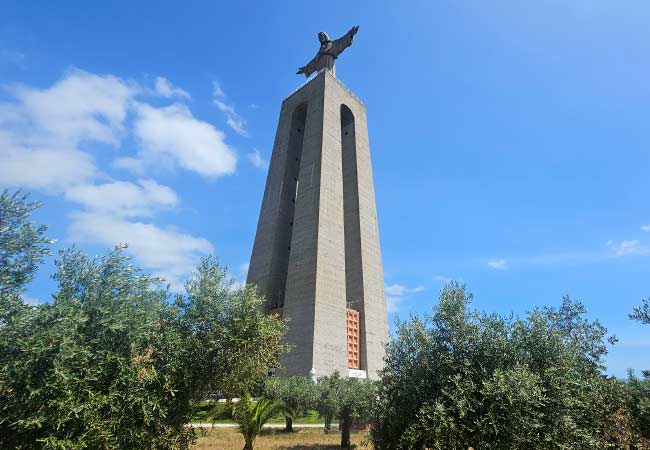
The Cristo Rei statue standing high above the Tejo River
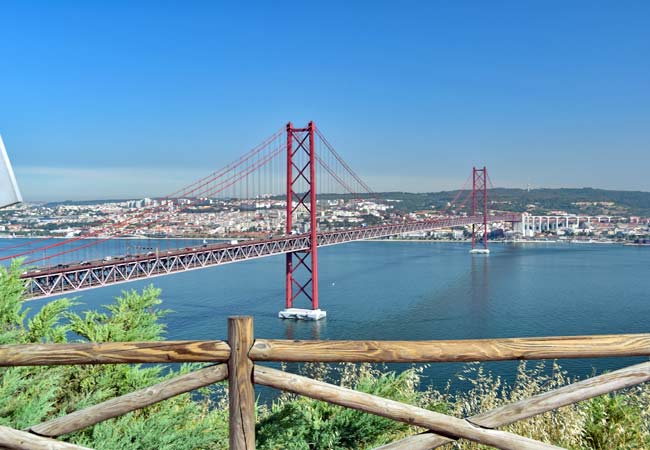
The view over the 25 de Abril bridge
Travel to Cristo Rei - the options
My recommended way to reach Cristo Rei is to take the ferry from Cais do Sodré (in Lisbon) to Cacilhas, and then catch the 3001 bus from Cacilhas to Cristo Rei. The entire route takes less than one hour (depending on connections), and the return trip costs less than €5.
Another option from Cacilhas ferry terminal is to walk along the Rua do Ginjal to Cristo Rei. This route ascends the cliffs at the Boca do Vento Lift, but the cliff-top section is surprisingly long at 1.8km, and passes through bland residential neighbourhoods. I personally would save the Rua do Ginjal and walk to the Ponto Final restaurant after visiting Cristo Rei.
It is possible to catch an Uber or Bolt from Lisbon to Cristo Rei, and this would be my choice if I were limited for time or travelling with children. The route is 14km from the Baixa district to Cristo Rei, and a traffic-free journey takes around 20 minutes. A typical fare is around €12 for up to four people. However, heavy traffic around the Ponte 25 de Abril can significantly increase the fare. Uber and Bolt drivers must pay the toll for the 25 de Abril bridge (€2.15) when heading back into the city.
If you have a car, it is very easy to drive to Cristo Rei, and there are lots of parking spaces at the complex (€2) or free parking on the surrounding roads. The drive to Cristo Rei crosses the Ponte 25 de Abril suspension bridge; however, during rush hours, the bridge is a major bottleneck, with traffic jams heading north into the city at the toll stations.
There is no direct bus service from Lisbon to Cristo Rei, and the closest stop is on the A2 expressway just after the 25 de Abril bridge (GPS: 38.673, -9.173 - link to Google Maps). From here, it is a 15-minute (850m) uphill walk to Cristo Rei. For a first visit to Cristo Rei, I would not choose this bus option.
This bus is useful when you want to return to Lisbon, as the walk is shorter (it's downhill, and you do not have to cross the A2). There are also many departures, as every bus heading into Lisbon stops here.
My opinion: Of all the options, the ferry and bus route is the best way to travel to Cristo Rei. The ferry and bus is simply more fun, with a boat ride across the estuary and time to explore Cacilhas
The following sections will explain in detail the journey from Lisbon to Cristo Rei via Cacilhas.
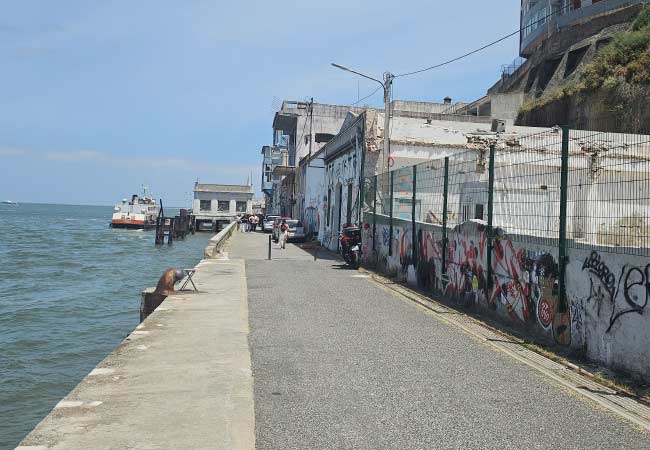
The Rua do Ginjal waterfront footpath could be one of the most scenic walks in Lisbon but currently it feels neglected
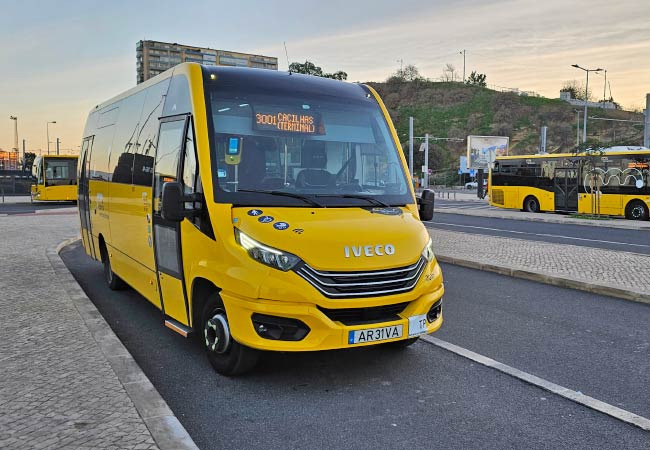
The 3001 bus waiting in Cacilhas bus station
The ferry from Lisbon to Cacilhas
The first stage of the journey to Cristo Rei is to cross the River Tejo. There is a regular and inexpensive ferry operated by TransTejo that departs from the Cais do Sodré ferry terminal and crosses the Tejo to Cacilhas.
The Cais do Sodré ferry terminal is part of the Cais do Sodré railway station complex, which is the departure station for all trains heading westward along the Estoril coastline to Cascais. Cais do Sodré train station is the final stop on the green metro line, and the ferry terminal is a separate building just outside the train station.
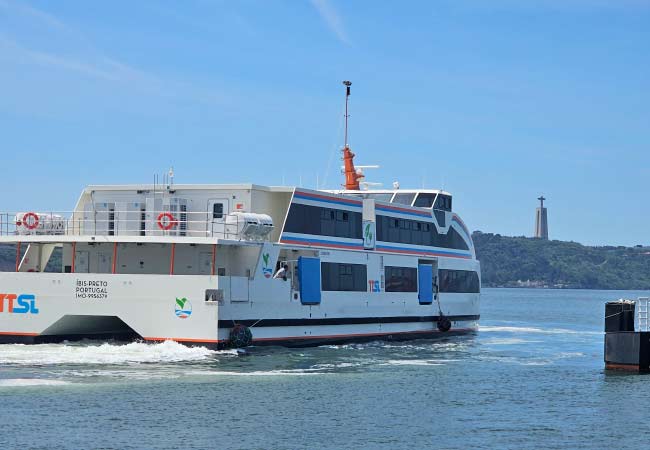
The ferry to Cacilhas
The Cais do Sodré to Cacilhas ferry is an important commuter route, and the number of departures reflects this. At peak hours, there are up to seven departures per hour, with services starting early in the morning and continuing late into the night. There are fewer services at weekends (two or three departures per hour), and the latest timetable can be seen on the TransTejo website:
ttsl.pt/passageiros/igacao-cacilhas-cais-do-sodre/
(The link opens a new tab)
Advice: It is best to avoid using the ferry at rush hour, when it will be crowded with commuters.
A single ferry ticket costs €2.00 and is charged to the Navegante card, the public transport card used throughout Lisbon. The initial purchase of this card costs €0.50. Tickets can be purchased from the ticket office or ticket machines. These machines have instructions in all major European languages and are easy to use. It is only a short ferry ride, with the crossing taking just 10 minutes.
This ferry route uses the new electric catamaran ferries, and the crossing is relatively smooth even in choppy water, and surprisingly quiet, especially when I remember the old orange ferries, whose constant bobbing made everyone feel seasick.
Insight: Sadly, the ferry has no outside viewing area, but head to the upper deck for better views.
When departing from Lisbon, the right side (starboard) will have views of the 25 de Abril bridge, while the left side (port) has better views of Lisbon's waterfront.
From the ferry terminal, it is a very short walk (150m) to Cacilhas bus station. Before catching the bus, it is worth having a wander around Cacilhas.
How about a small group tour?
One of the best ways to discover Lisbon and to meet fellow travellers is to join a guided tour. We have worked with Getyourguide.com for the last seven years, and some of the best tours of Lisbon include:
The bus from Cacilhas to Cristo Rei
The 3001 bus service operated by Carris Metropolitana connects Cacilhas to Cristo Rei. The 3001 is a seasonal service that has two to three departures per hour in summer, dropping to hourly in the winter. The latest timetable can be seen on the Carris Metropolitana website:
/www.
A single bus fare is €1.30, paid in cash to the driver, or €0.85 with prepaid Zapping credit on a Navegante card. On some vehicles you can also tap a contactless bank card at the yellow validator, but it is always worth carrying cash. In Cacilhas bus station, each of the bus stands is clearly labelled with the services that depart from it.
The bus journey from Cacilhas to Cristo Rei passes through the residential and shopping streets of Cacilhas and Almada, and takes 15 minutes. The 3001 bus terminates in front of the administrative building of the Cristo Rei complex, and it is a short walk to the statue.
Insight: If there is a long wait for the 3001 bus, you may wish to take an Uber or Bolt (€4), or a taxi (€6). There may be tuk-tuks or other tourist vehicles, which charge €5 per person.
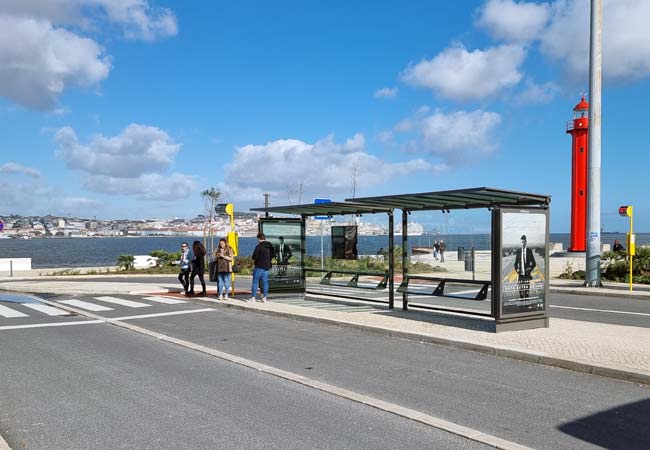
The bus stop for the 3001 bus in Cacilhas
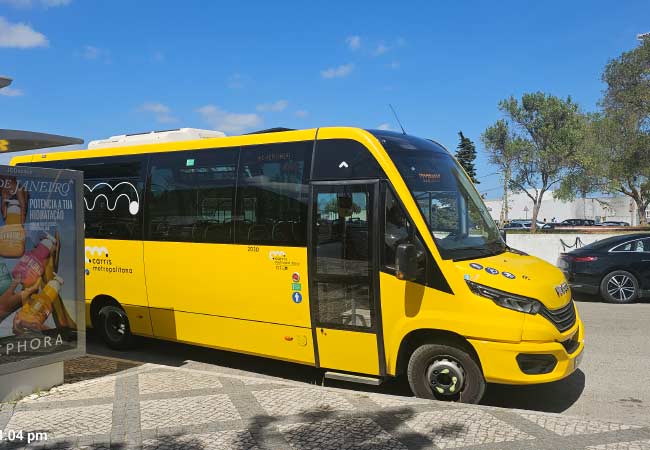
The bus at Cristo Rei
The walk along the Rua do Ginjal
It is possible to walk along the riverside Rua do Ginjal path to the Jardim do Rio and the Boca do Vento Lift. The lift then transports passengers to the top of the cliffs, as well as offering a sweeping viewpoint over the estuary. From the cliff top it is 1.8km to the Cristo Rei, and there is no direct route. To me the path always feels much longer, especially with the wide uphill loop on the Avenida do Cristo Rei.
I have taken this walk more than ten times over my 25 years of visiting Lisbon, and I always have the same thought just as I start the Avenida do Cristo Rei section, with the sun blazing down and the 3001 bus passing me: "why did I bother to choose this?" For your first trip I would take the bus and skip the cliff-top residential walk, as there is very little to see.
There has been significant work to improve the Rua do Ginjal. Previously there were abandoned warehouses and docks, which constantly threatened to collapse and were home to many dodgy characters. For what could be one of the most scenic walks in Lisbon, it always had a slightly threatening atmosphere, so much so that my wife and I used to refuse to walk it once the sun had set. Now, with the buildings cleared away, it feels a lot safer, but it still carries an air of neglect.
For me the walk along the Rua do Ginjal to the Jardim do Rio is much better after you have visited Cristo Rei and returned to Cacilhas. Visiting the Jardim do Rio later in the day is also a great idea, as it is one of my favourite spots to watch the sunset. Unlike many other places in Lisbon, where the setting sun is obscured by hills, here at the Jardim do Rio you can watch it sink over the ocean and the mouth of the Tejo estuary, with the suspension bridge silhouetted against it.
The Jardim do Rio is where I have taken my wife for many romantic evenings, bringing our own bottle of wine and an evening nibble-picnic. If you are after an inexpensive romantic activity, I highly recommend it.
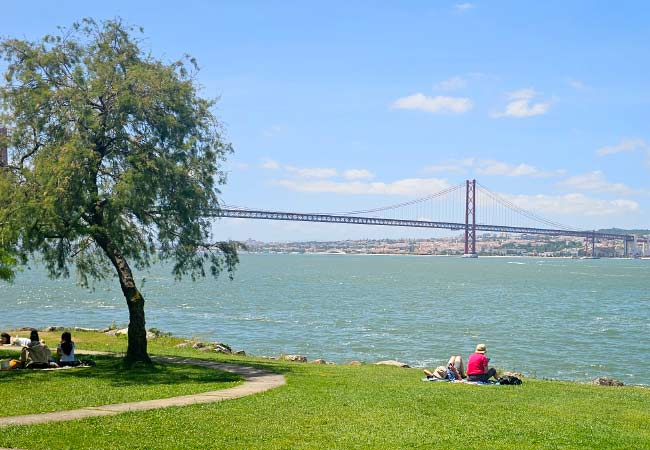
The Jardim do Rio, rarely busy and a pleasant place to spend a lazy summer’s afternoon
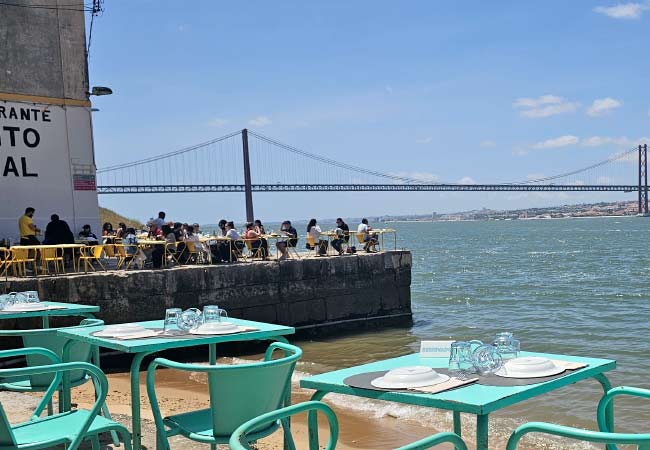
Sitting on the edge of the estuary is Ponto Final, arguably Lisbon’s most famous restaurant due to its social media fame.
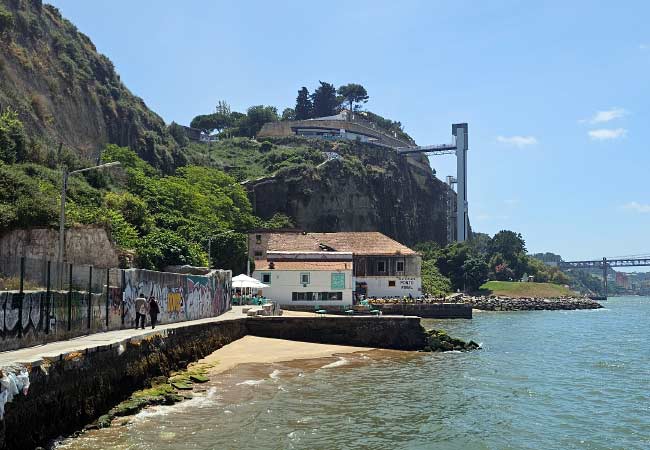
This is the actually the setting of Ponto Final…
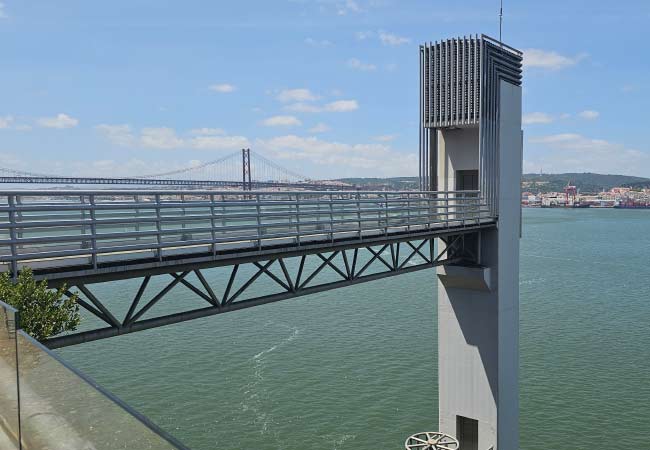
The Boca do Vento lift means there is no need to climb the steep path from the base of the cliffs, and its free!
Cacilhas
Cacilhas is known for its inexpensive seafood restaurants and cervejarias (beer houses), which line the main plaza and the Rua Cândido dos Reis. These are great for a quick lunch and are much cheaper than central Lisbon. Some of the best are listed below.
My four go-to places, which even my Portuguese mother-in-law is happy to eat at (so they must be good), are 'A Toca', 'Cova Funda', 'Cabrinha' and 'Solar Beirão'. All serve traditional Portuguese food along with decent fresh fish. Other good options are 'Meating Steakhouse' and the Korean barbecue restaurant Han Table Barbecue. My only word of warning is to choose somewhere before heading into Cacilhas, as there are a number of poor restaurants close to the ferry terminal, with waiters enticing customers in.
The main sight of Cacilhas is the Dom Fernando II e Glória ship, the last sailing ship of the Portuguese Navy. This grand frigate has been lovingly restored and can be visited for €7. Also included in the entrance fee is the NRP Barracuda, a 1960s submarine that was retired from service in 2010 and had a crew of 56 in its cramped hull.
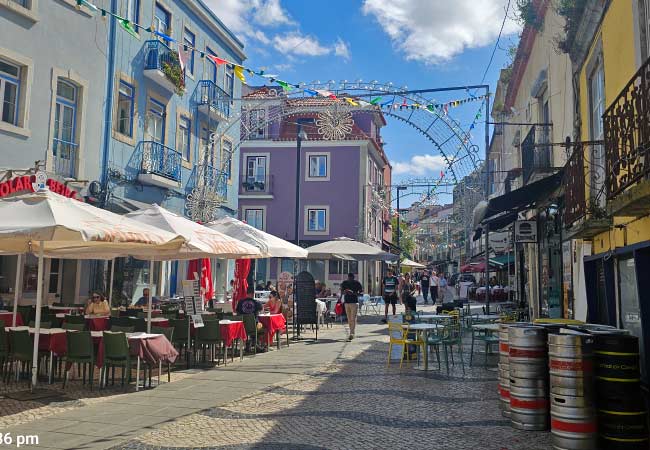
The restaurants along the Rua Rua Cândido dos Reis. This is the street you want to be eating on
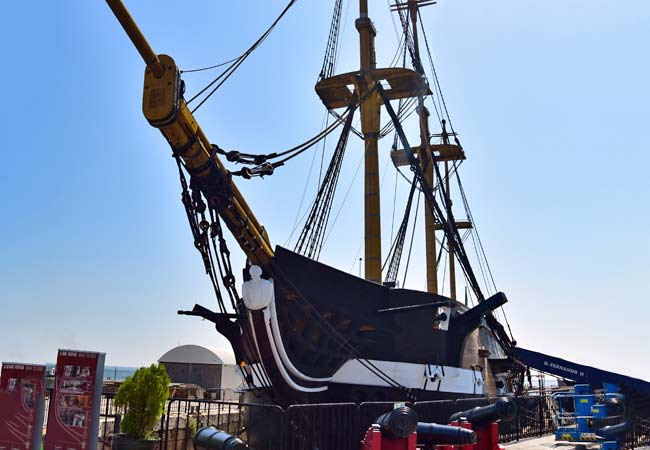
The Dom Fernando II e Glória, the end of a glorious era of sail for the Portuguese Navy
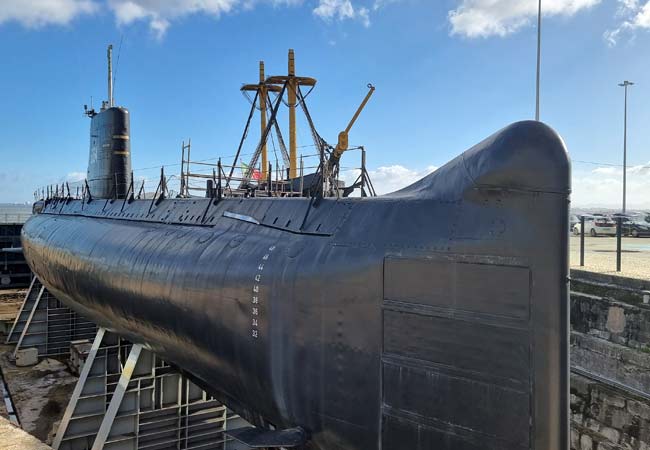
The NRP Barracuda submarine, I can’t imagine being in something so small for months at a time with 56 other people
Cristo Rei tourist information
The statue of Cristo Rei stands high on its pedestal, with its arms outstretched in blessing over Lisbon. The site is a religious complex and pilgrimage destination, but for most visitors the real draw is the amazing views over Lisbon and the estuary.
The complex itself is free to enter, and a ticket is needed only for the viewing platform 80m up. The ticket price is €10 (€3 for children aged 8 to 12, free for under-8s) and, honestly, I do not feel it is worth it. The viewing platform at the top is surrounded by a high fence, and this ruins the background for any photos. Photos from the cliff top are just as good and much better for selfies, couples or groups.
There is also a single lift to the top of the monument, and at peak times there can be a long queue to ride it. This queue is on the opposite side to the ticket office, so before buying, check that the queue is an acceptable length.
Within the Cristo Rei complex is a café serving simple meals, drinks and snacks, but any main meal is better eaten in Cacilhas. The site is open from 10am and shuts at 7pm (summer) or 6pm (winter), and full details can be found on the Santuário Nacional de Cristo Rei website: https://cristorei.pt
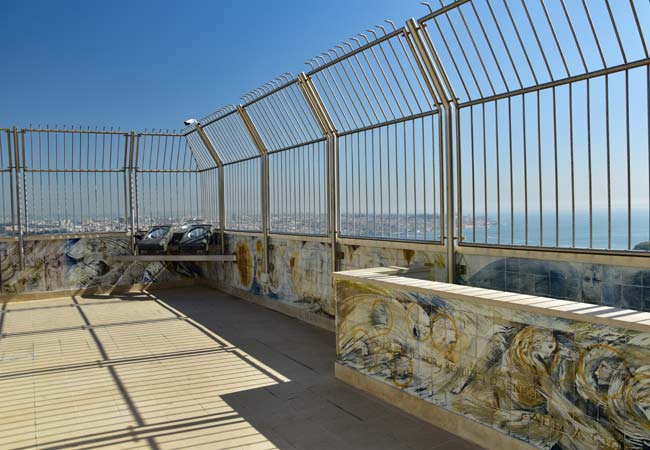
The viewpoint at the top of Cristo Rei, with the protective fences that ruin any photos
The viewpoint at the top of the cliffs in my opinion is much better for selfies or group photos
The return back to Lisbon
After visiting Cristo Rei, you could return to Lisbon by the same means you arrived, but a faster method is to catch the bus from the edge of the A2 expressway.
This is a scenic bus ride back into Lisbon, as it crosses the 25 de Abril bridge. There are many departures from this bus stop, as every bus service heading north stops here (such as buses from Sesimbra, Costa da Caparica, Setúbal and Almada). Generally, all of the bus routes into Lisbon terminate at the Sete Rios bus station or at the Marquês de Pombal plaza, and both stops are connected to the metro.
When riding the bus back into Lisbon, try to sit on the same side as the door, as this will provide the best views of the River Tejo and Lisbon.
The bus stop for services into Lisbon is situated on the eastern side of the A2 (GPS: 38.674, -9.173), and there is no need to cross the road to reach it. There is a path that leads down to the A2 from Cristo Rei, accessed by taking the right-hand road from the roundabout in front of the statue.
While you could take these bus routes from Lisbon to Cristo Rei, I don't recommend this approach. The journey involves a steep uphill walk from the 25 de Abril bridge bus stop to Cristo Rei, requires crossing ten lanes of traffic via a bridge, and can be confusing due to the multiple departure locations in Lisbon.
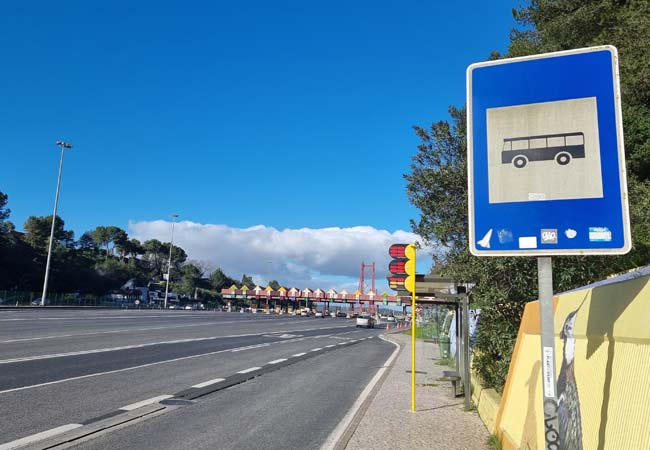
The bus stop on the side of the A2 expressway, when heading back into Lisbon
Discover more of Lisbon with our most popular guides




About this guide: I'm Philip Giddings. I live in Graça with my Portuguese wife Carla, whose family are Lisboetas going back generations. I've been visiting Portugal since 2001, writing the independent guides at LisbonLisboaPortugal.com since 2009, and the site is now my full-time work. Carla first brought me up to Lisbon on an early trip, and twenty-five years on we are still walking the city together: summers on the packed beaches, quiet Saturdays at the Feira da Ladra, and hunting for a heater for our flat when the chilly winter arrives.
This site has 189 guides on Lisbon. It takes no payment from tourist boards, tour operators, or attractions for inclusion, and is funded by affiliate commissions on tour bookings, disclosed on every page that contains them. Every practical detail (ticket prices, opening hours, bus routes, time-slot policies) is checked against the official sources and verified in person on the walks I make through the city each week. Read the full story here.