LisbonLisboaPortugal.com
The best independent guide to Lisbon
LisbonLisboaPortugal.com
The best independent guide to Lisbon
Lisbon to Belem - how to travel to Belem in 2026
Belém is a picturesque district to the west of Lisbon, home to many of the city's most famous landmarks. I love it because it is a breath of fresh air compared to the compact city centre, with green parks overlooking the refreshing waters of the Tejo estuary. Most visitors come for the obvious highlights, and rightly so: the Torre de Belém, the Mosteiro dos Jerónimos, the Padrão dos Descobrimentos, and a warm Pastel de Belém from the bakery that has been producing them since 1837.
Belém is some distance from the city centre (6km), so when I head there, I have the same dilemma as you: what is the best way to travel to Belém? This is in part because there is no clear "good" option, as the area is not connected to the metro, and all public transport seems to take an unnecessarily long time.
Personally, I often choose an Uber as my flat in Graça is further from the transport hubs, however if I am with friends in the Baixa we will take the tram, but be prepared for the 40 minute ride. Interestingly, my older Portuguese Tia (aunt) will only take the bus, as she dislikes the jostling as people get on and off the tram and worries about pickpockets.
The one thing none of us would consider is the train, which has oddly become a popular recommendation on social media. The reality is that queueing in Cais do Sodré station to buy a ticket from an ancient machine, only to travel one stop, makes very little sense when a tram (or Tia's bus) leaves every few minutes from the city centre.
This guide covers every transport option to Belém and explains which is best depending on where you are staying, how many of you are travelling, and how much patience you have for Lisbon's public transport quirks.
Related articles: Guide to Belem
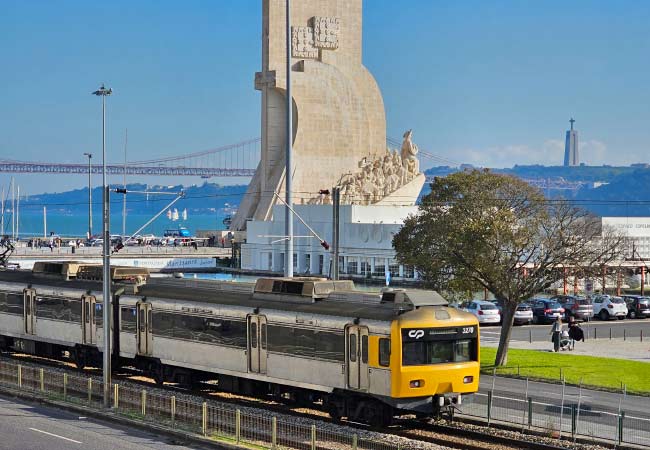
The train passing through Belem with the Padrão dos Descobrimentos monument to the rear
All the options for travelling from central Lisbon to Belém
If I had to order all of the options of traveling from central Lisbon to Belem in the preference of me taking them, convenience and price, I would order them:
1) Ride-hailing app (Uber or Bolt)
2) Tram (route E15)
3) Bus (route 728)
4) Train
5) Taxi
6) Tuk-tuk (or other gimmicky tourist transport)
Insight: There are no metro lines to Belem or the western side of Lisbon.
Note: Full details of each method are explained later in this guide.
Uber or Bolt are the quickest and most convenient method of travelling to Belém, and as bad as they are for traffic and pollution, this is the option I would suggest for most visitors. They remove the hassle of finding bus or tram stops or trying to buy tickets from impatient drivers. The journey time by Uber is half that of the tram, and in a car you are guaranteed a seat and do not have the worry of someone stealing your wallet.
The typical Uber or Bolt fare to Belém from central Lisbon is €6 for up to four people, which is the same price as two adult tram tickets (€3.30 for a single ticket purchased on board).
If you do not have the Uber or Bolt apps installed on your phone, the E15 tram is the best public transport option. This tram route offers frequent departures to Belém, starting from Praça da Figueira in the heart of the Baixa district. Along its journey, the tram also passes through the Praça do Comércio, Cais do Sodré and the Alcântara district.
The issue is that the tram is the main public transport for western Lisbon, so it will be busy, often standing room only, and this is when pickpockets are at their worst. As the tram is frequently crowded, makes frequent stops and you are often standing the whole way, I always feel the journey is much longer than it actually is.
The Lisbon to Cascais railway does stop at Belém, and it is possible to catch the train, but no resident or local is quite sure why you would. First, Cais do Sodré station needs to be reached, either by metro or on foot. Second, as the train line serves all of the beaches along the coastline, it will be extremely busy during the summer. Belém train station is also to the east of the district and is a long walk to the Torre de Belém (1.7km) or the Mosteiro dos Jerónimos (500m).
The reason the train option has been pushed on social media, and then regurgitated by travel influencers, is that during 2022 to 2024 the E15 tram had major works in the Baixa district and only departed from Cais do Sodré station. Those works are now complete.
The 728 bus is a great option for locals but can be difficult for tourists. The main complaint is trying to figure out which service, bus stop or direction is heading to Belém. The fastest cross-city route is the 728, and it is a very good option if you are based in the Alfama district. I personally find the bus most useful when heading back to central Lisbon from Belém at the end of the day, when demand for Ubers is at its highest. Most tourists heading back choose the E15 tram, leaving the bus much quieter, and conveniently the buses to central Lisbon leave from the same stop as the tram.
A taxi will be more expensive than Uber or Bolt, around 30% more, but is a sensible option if you have not installed one of the ride-hailing apps on your phone or are not comfortable using them. Always check the driver is using the meter, as taxis in Lisbon are notorious for trying to exploit tourists. Sadly I have been caught out myself on airport runs, so I cannot honestly recommend them to friends.
A tuk-tuk or other gimmicky tourist transport will always be significantly more expensive than every other option. This is a tour and an experience, not a practical way to travel around the city.
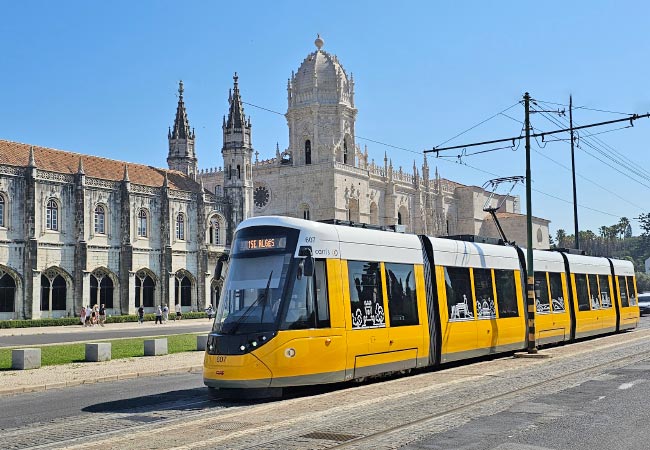
The E15 tram passing the Mosteiro dos Jeronimos
How about a small group tour?
One of the best ways to explore Lisbon is to join a small group tour, especially in the first days of your trip when you are still finding your bearings. I have worked with GetYourGuide for the last seven years and have personally taken several of their Lisbon tours. Some of the best include:
Travel to Belém via the E15 tram
The tram is the recommended means of public transport to Belém.
The number 15 tram departs from the Praça da Figueira (GPS 38.713, -9.138 - link to google maps), passes through the Praça do Comércio (GPS 38.708,-9.136) and stops at the Cais do Sodré train station (GPS 38.706, -9.145) before heading to Belem.
The tram journey takes 40 minutes from Praça da Figueira to Belém, but the route is very scenic as it passes beneath the suspension bridge and through many traditional areas of Lisbon. On the return, this journey will feel much longer, when you start to notice the crowding, the number of stops and the jostling in and out at every one.
Insight: The tram passes through the Alcântara district, the area around the suspension bridge, and this area complements a trip to Belém. Alcântara is the creative side of Lisbon, home to the LX Factory, many trendy bars and restaurants, and the higher end Doca de Santo Amaro waterfront.
Tram fares and how to pay
A single ticket purchased on board costs €3.30. Cash fares are paid to the driver or if you are using a bank card (Visa or Mastercard only), you can pay at the Validator Terminal located near the entrance. The Validator Terminal only accepts bank cards or mobiles with NFC technology, while the driver only accepts cash. Using the Validator Terminal, you can purchase tickets for up to 10 passengers in your group.
The tram service is operated by Carris, and their website is www.carris.pt/
The single fare is convenient but adds up quickly. A return trip to Belém on single tickets will cost €6.60 per person, which is more than an Uber for up to four people.
If you are in Lisbon for a few days, I would suggest getting a Navegante card and charging it with credit, which can be used on all public transport in the Lisbon region. This pre-loaded credit system is called 'Zapping' and reduces the single tram fare to €1.72. Using Zapping is easy: each time you travel, you simply swipe when boarding and the journey cost is debited from your available credit. The only issue is that you can only preload credit at a metro station, the nearest to the start of the E15 tram route being Rossio.
Personal Insight: When friends come to Lisbon, I give them a Navegante card loaded with €15 of Zapping credit. This removes the hassle of trying to buy tickets on the trams, buses or metro, and makes travel much cheaper.
In Belém, the best stop for sightseeing is the 'Mosteiro Jerónimos' stop (GPS 38.697, -9.204), which is close to the monastery and the Praça do Império. The 'Belém' tram stop (GPS: 38.697, -9.198) is convenient if you wish to begin your sightseeing at the Museu dos Coches. The E15 tram line terminates at Algés, and this will be displayed on the front of the tram.
Warning: The E15 tram can get very packed and is frequently targeted by highly skilled pickpockets. When on busy trams, always be cautious with your valuables, especially if you are standing by the doors. The common trick is to snatch items just as the doors are closing, leaving no time to react.
The interactive map below displays the route of the E15 tram, with the major stops shown in green. The map also includes the major tourist attractions along the route as yellow pins. (Note: Zoom out or in to see all the points.)
Major tram stops: 1) Praça da Figueira 2) Praça do Comércio 3) Cais do Sodré 4) Cais da Rocha 5) Calvário 6) Altinho (MAAT) 7) Mosteiro dos Jerónimos 8) Largo da Princesa
Tourist attractions along the route: 9) Praça do Comércio 10) Pink Street 11) TimeOut Food market 12) Museu Nacional de Arte Antiga 13) LxFactory 14) Santo Amaro docks 15) Capela de Santo Amaro 16) MAAT museum 17) Museu dos Coches 18) Mosteiro dos Jerónimos 19) Padrão dos Descobrimentos 20) Torre de Belém
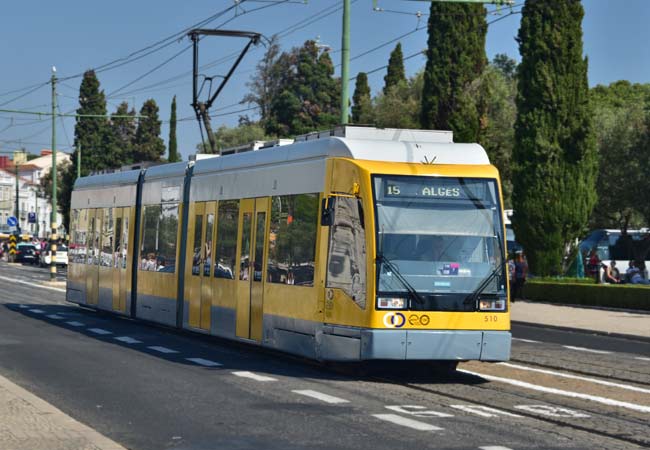
Travel to Belem by Uber or Bolt
I use Uber for almost all of my travel within Lisbon. It is convenient with door to door travel, prices are surprisingly cheap, and they have not increased as they have in many other cities. The competition between Bolt and Uber and the number of drivers in Lisbon keeps fares low.
There are two ride-hailing apps in Lisbon, Uber and Bolt, with both offering very similar services. If you have either app already installed on your phone and have used them before, these are the recommended means of travel to Belém.
The roads to the west of Lisbon are comparatively fast and free of traffic, and the journey from Cais do Sodré to Belém will take around 15 minutes, a third of the time of the tram and about the same time it takes to queue for train tickets. The fare for this ride will cost around €6, but the exact amount will depend on demand, and it can be difficult to secure drivers at peak times.
For the drop-off point, choose the road just to the south of the Mosteiro dos Jerónimos, which is also close to the tram and bus stop (GPS 38.697, -9.204).
If you have never used Uber or Bolt, I would recommend downloading and setting up the app in the comfort of your accommodation, or even at home before your trip to Lisbon. Trying to do this over mobile networks can be frustrating.
Note: Fares are charged in Euros, so ensure you have a bank card or account that does not charge conversion fees, otherwise these can quickly add up.
Advice: When ordering an Uber or Bolt, always try to choose a pick-up point free from heavy traffic, and somewhere the driver can easily see you. There are many complex one-way systems in central Lisbon, and if the driver misses you they may have to take a long route to return to you.
Travel to Belém by train
Train travel to Belém is an option, but it is not one I would recommend for most visitors.
The train departs from Cais do Sodré station, which is some distance from where most tourists are based in the Baixa or Alfama, and getting there first adds time to an already roundabout journey. The E15 tram actually passes right by Cais do Sodré on its way to Belém, so if you find yourself at the station, you may as well stay on the tram. That said, it is worth glancing at how busy the trams are as they pass, and if they are packed, the train becomes a reasonable backup.
There are three departures every hour, and the train journey itself is faster than the tram or bus as it does not need to contend with Lisbon's traffic. The train terminates at Belém station (GPS 38.696, -9.197), which is to the east of the district, 750m from the Mosteiro dos Jerónimos and 1.5km from the Torre de Belém, so there is a fair walk at the other end.
The train fare requires a 'Zone 1' ticket and costs €1.35, charged to a Navegante card (€0.50 for the initial purchase). If you already have a Navegante card with Zapping credit, you can skip the ticket queues entirely by swiping through the barriers, and I would strongly suggest doing this. The ticket machines at Cais do Sodré are old and overly complex, and during the summer, when everyone is heading to the beaches along the coast, the queues at the ticket office can be very long.
The train used to be a more practical option when the trams were cash only, but now that the E15 has the Validator Terminal accepting bank cards on board, there is even less reason to choose it.
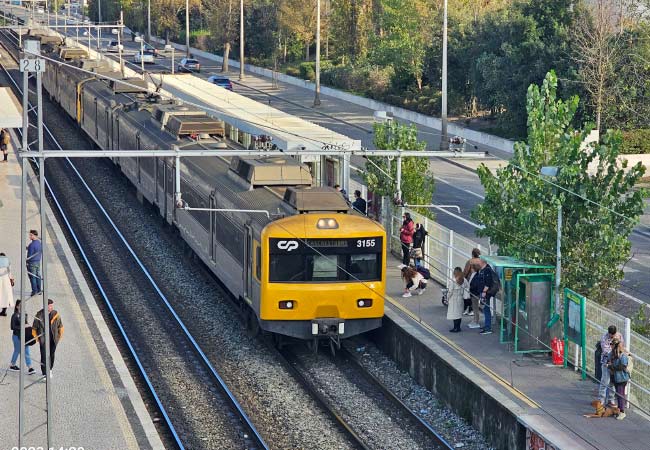
Belem train station
The bus to Belem
There are many bus routes to western Lisbon that pass through the Belém district.
The most useful is the number 728 route, which displays Restelo when heading westward to Belém. This is a fast, circular route that follows the waterfront and conveniently stops at the southern side of the Praça do Comércio (GPS: 38.706, -9.137) and Alfama (GPS: 38.711, -9.126). The 728 is the only direct option to travel from Alfama or the eastern side of Lisbon to Belém, and it continues past Santa Apolónia station all the way to the Parque das Nações (Oriente) district in the northeast.
A bus fare purchased on board costs €2.30 but is reduced to €1.72 when the Zapping ticket is used.
As mentioned earlier, the bus is particularly useful for coming back from Belém, which usually aligns with rush hour. At that time there is very high demand for Ubers and it can take a long time to connect to a driver. The tram is also at its busiest with a mix of tourists and commuters all heading to central Lisbon. This makes the bus a sensible alternative, especially as they all pass through the central tram and bus stop near the Mosteiro dos Jerónimos.
From the Mosteiro dos Jerónimos bus and tram stop, the following services also depart:
• Bus 728: Cais do Sodré, Praça do Comércio, Santa Apolónia (for Alfama), Museu Nacional do Azulejo, continuing to Oriente. Departures every 15 to 20 minutes.
• Bus 727: Estrela, Rato, Marquês de Pombal, Roma-Areeiro.
• Bus 714: Cais do Sodré.
My Tia prefers the bus in both directions. After half a century of living in Lisbon she has memorised all of the routes, which still confuse me as the labels on the front only show the final destination. She likes it as there is a much higher chance of getting a seat for the long journey, and almost no reports of pickpockets on buses. She also gets the chance to complain to other Portuguese bus passengers about the usual things: tourists, delays, rising costs, in the typical Portuguese way. As a visitor, I would stick to the tram or Uber.
Discover more of Lisbon with our most popular guides





About this guide: I'm Philip Giddings. I live in Graça with my Portuguese wife Carla, whose family are Lisboetas going back generations. I've been visiting Portugal since 2001, writing the independent guides at LisbonLisboaPortugal.com since 2009, and the site is now my full-time work. Carla first brought me up to Lisbon on an early trip, and twenty-five years on we are still walking the city together: summers on the packed beaches, quiet Saturdays at the Feira da Ladra, and hunting for a heater for our flat when the chilly winter arrives.
This site has 189 guides on Lisbon. It takes no payment from tourist boards, tour operators, or attractions for inclusion, and is funded by affiliate commissions on tour bookings, disclosed on every page that contains them. Every practical detail (ticket prices, opening hours, bus routes, time-slot policies) is checked against the official sources and verified in person on the walks I make through the city each week. Read the full story here.