LisbonLisboaPortugal.com
The best independent guide to Lisbon
LisbonLisboaPortugal.com
The best independent guide to Lisbon
The number 12 tram, Lisbon
While queuing for the number 28 tram in Martim Moniz, I am always hoping the number 12 makes an appearance, as it guarantees me a ride to Alfama without the long wait, and even the possibility of a seat.
Tram 12 is Lisbon's shortest tram route at 2.6km, connecting Martim Moniz to Praça Luís de Camões. In its westerly direction it passes through Alfama, Baixa and Chiado, and can be thought of as a mini version of the much longer 28. The return leg of the 12, heading east, is much longer, being forced to also take in Graça and Intendente, as there is a one-directional section of track at Calçada de Santo André. So, as a tourist, whatever the situation with queues or your location, if a number 12 tram turns up, jump on it and consider it a cut-down version of the 28.
I have lived in Graça for the last six years and the number 28 tram is my only public transport up the hill to my flat, so while waiting for it in Martim Moniz or the sections in Baixa, I often sense and hear the confusion among visitors when the 12 turns up.
If you are wanting a ride on a historic tram, and to pass through the scenic areas of Alfama and Baixa, the number 12 is great. It covers many of the best stretches of the 28's route, including the narrow streets of Alfama, the Portas do Sol viewpoint, the cathedral and the grand avenues of Baixa. The real bonus is that at the departure points of Martim Moniz and Praça Luís de Camões, few tourists want to ride it, as they don't know where it is going and often have a ride on the 28, not the 12, on their checklist of activities. This is the tram route I rode with my young nieces and nephews when they wanted a ride on a Lisbon tram, as I would never consider taking them on the overly crowded 28 at five and seven years old.
This guide details the number 12 tram based on my first-hand experience as both a local resident and a visitor, using it to get home to Graça and riding it for fun with my brother's young family. I will cover fares, tips for getting the most from your journey, and the key sights along the route.
Related articles: The number 28 tram
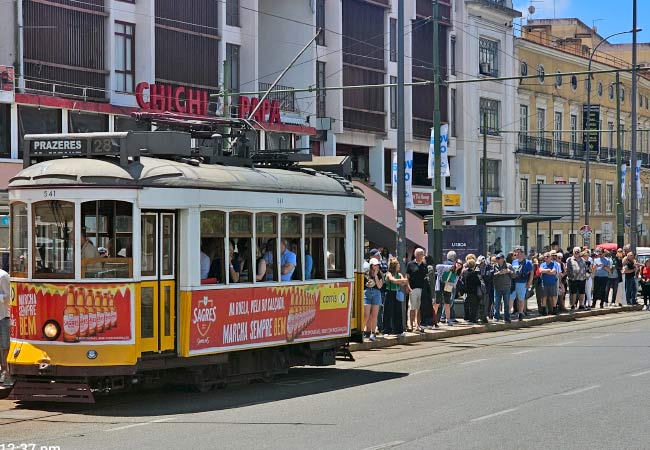
The long queue for the 28 tram in Martim Moniz. If a 12 turns up I would ride it
Quick details for the 12 Tram
Before I launch into the full details about the tram, its route and sights, here are some quick details to answer any immediate questions you may have:
Onboard ticket price: €3.30
Cheapest fare: Zapping, €1.72 (explained in detail later)
Bank card: contactless payment can be made using the ticket validator. (I would always carry cash as a backup.)
Service: first tram 08:00, last 20:45 (weekdays); roughly every 30 to 40 minutes, sometimes only once an hour. In reality the service is too infrequent to plan a trip around, so I regard it as a bonus to the much more frequent 28.
Most scenic section: Portas do Sol to Praça Luís de Camões. Best time to ride: early morning, before 10am.
The 12 tram route:
• Heading west: Martim Moniz - Calçada de Santo André - Portas do Sol (Alfama) - Sé Cathedral - Rua da Conceição (Baixa) - Praça Luís de Camões (Chiado)
• Heading east: Praça Luís de Camões - Rua da Conceição - Sé Cathedral - Portas do Sol - Graça - Intendente - Martim Moniz
The route heading east is much longer and follows the exact route of the 28, as the tram tracks run in only one direction along the Calçada de Santo André. This is better shown on the map below. The light yellow is the westerly route, and the orange route is the easterly service.
The green line marks the walking route up to the castle from the Portas do Sol tram stop.
At either end of the service (Martim Moniz or Praça Luís de Camões) all passengers must get off. It is not possible to stay on board and ride the tram back.
Fares for the number 12 tram
A single ticket for the number 12 tram purchased on board costs €3.30.
Cash tickets are bought from the driver and bank card tickets (Visa or Mastercard only) can be purchased from the validator terminal located near the entrance. The validator terminal only accepts bank cards (or mobiles with NFC technology), while the driver only accepts cash, not cards. I always have cash with me in case my bank card does not work, or the validator terminal machine is running really slowly (or without connection). My advice is always to have some cash (around €20) while sightseeing in Lisbon.
The option I use to pay for public transport is "Zapping". This pre-loads credit onto the Navegante card, which can be used on public transport across the Lisbon region. The Zapping fare is much cheaper, costing only €1.72 for a single tram ride. The annoyance with this ticket is that the Zapping credit cannot be bought on board the tram and has to be purchased from a metro station. If you are in Lisbon for a few days, I suggest getting a Navegante card with €15 of credit loaded, which can be used everywhere, including the train to Sintra and the ferries.
If you are planning to do a lot of sightseeing in a single day, my suggested option is to purchase the 24-hour unlimited public transport ticket, which costs €7.25. This 24-hour ticket is great value for visitors, as it includes travel on all of the tram routes (€3.30 each), the funiculars (€4.30 single) and Elevador de Santa Justa (€6.20 return), in addition to the metro and buses. Again this can only be purchased from a metro station. If you are in Martim Moniz waiting for the 28 or 12 tram, there is a metro station in the plaza where you can buy either the Zapping credit or the 24-hour ticket.
Insight: The number 12 tram route is identified as the E12 with the preceding “E” meaning Elétrico (the Portuguese for tram).
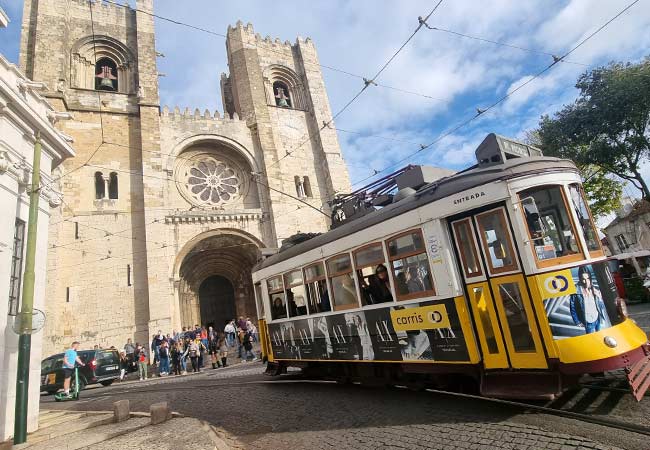
The number 12 tram passing the Se cathedral
Key stops along the 12-tram route
Martim Moniz
The departure location is unfortunately my least favourite plaza in Baixa. It has a rougher, more edge than the grand plazas down the hill, and at certain hours it can feel faintly unwelcoming. I would simply board the tram from here and not explore the plaza much further. The plaza itself is named after the knight (Martim Moniz) who, during the 1147 siege of Lisbon, is said to have thrown his own body into the closing gate of the Moorish castle so his comrades could storm through.
Calçada de Santo André
The tram grinds the up a steep hill into the Mouraria, the old quarter where Moors were resettled after the Christian reconquest. I will not pretend otherwise, I find certain sections of Mouraria grim. It has the run-down, unloved atmosphere that other guides politely call "characterful", with real problems of drugs and neglect in its narrow streets. It is sometimes described as Alfama's rougher cousin, and for once I would take the cliché at face value and explore Alfama instead. Ride the along the Calçada de Santo André, but I wouldn’t consider getting out until the Largo Rodrigues de Freitas.
Portas do Sol (Alfama)
The Portas do Sol is a delightful plaza constructed on what was once the gate to the city. It is the only really open space in Alfama, with its views down the hill to the waterfront and the terminal where the huge cruise ships moor.
There is always a tourist buzz about the place, photos being taken, a pastel de nata from Manteigaria and sounds of laughter from the Piña Colada bar. My wife, on the other hand, being Portuguese, gets annoyed by the crowds, the constant barrage of tuk-tuk drivers touting tours, and the inflated tourist prices at the kiosk. Even so, she will always stop for a selfie at the viewpoint. This is the best point to start any exploration of Alfama, and my suggestion is to head down the steps of the Rua Norberto de Araújo.
Sé Cathedral
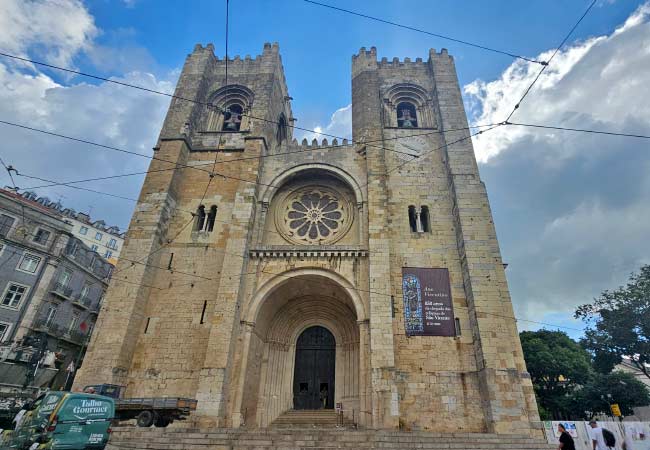
The Sé Cathedral, Lisbon's oldest church, looks more like a fortress than a place of worship, with two squat crenellated towers and a great rose window set into limestone walls. Begun in 1147 on the site of the city's main mosque, it has survived battles and the catastrophic 1755 earthquake, ending up an blend of Romanesque, Gothic and Baroque styles.
Close by is the church dedicated to Saint Anthony, Lisbon's beloved matchmaker saint, which was constructed on his birthplace. This is another popular stop for exploring more of Alfama. Honestly, I would have exited at Portas do Sol and walked downhill to this stop, following the tram tracks as my guide.
Rua da Conceição (Baixa)
This is the main stop along the tram route for the Baixa district, the grand downtown grid rebuilt from scratch after the 1755 earthquake flattened the old city. The wide, straight streets were an engineering marvel for their day, built on earthquake-proof timber frames and laid out by trade, with names like Silver Street and Shoemaker Street.
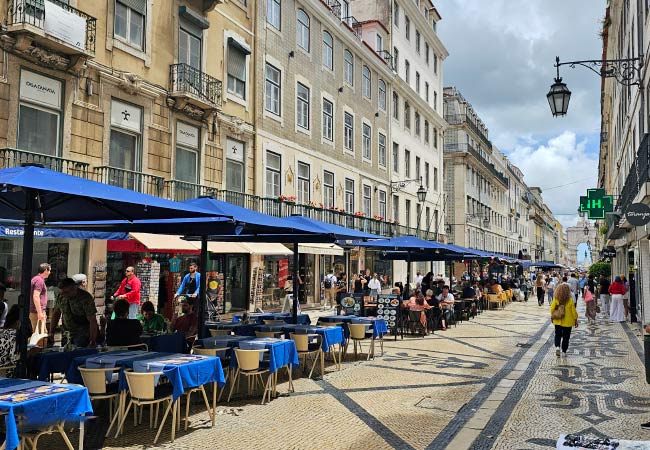
I would step off here to walk Rua Augusta, a bustling street where there is always something going on: street performers, open-air cafés and a wide selection of tourist shops. If you enjoyed the ambience of Portas do Sol, you will love Rua Augusta. Close by is the Praça do Comércio, the mighty riverfront plaza with its yellow buildings and triumphal arch.
Praça Luís de Camões (Chiado)
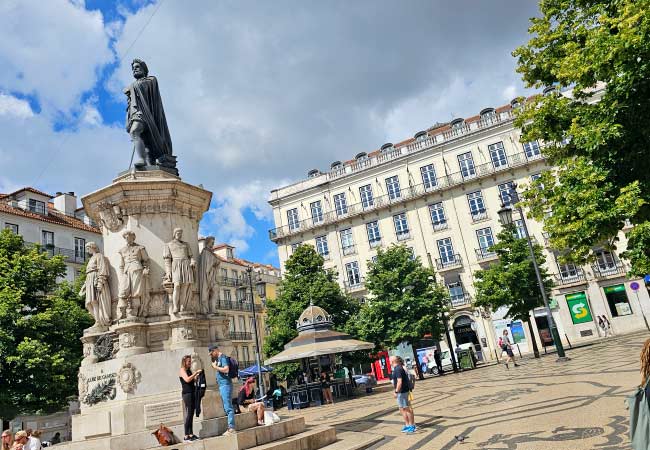
The line ends in the elegant, café-lined heart of Chiado, named after Portugal's national poet (Luís de Camões), whose statue presides over the square. Just around the corner sit the historic A Brasileira café, and the Livraria Bertrand, one of the oldest bookshops in the world. It is also the gateway to the Bairro Alto, whose steep lanes fill with bars and music once the sun goes down.
From the Praça Luís de Camões you can walk downhill towards the Cais do Sodré district, where Pink Street and the Time Out Market can be found. Personally, if I were exploring the city from here, I would walk eastwards through Chiado and down to Rossio.
Lisbon Tram 12 or 28?
The number 28 is the better route of the two, covering more of the city, but its sheer popularity often ruins the experience. On the 28 it is often standing room only, with long queues to board and pickpockets working the carriages.
The number 12 is a good alternative when the 28 is too busy. Both services use the classic Remodelado trams, and both pass through the scenic Alfama district.
Both the number 12 and 28 trams depart from the same plaza, Martim Moniz. This allows the informed visitor the option to board the less busy tram. Plan to ride the 28, but if there is a long queue when you reach Martim Moniz, switch to the 12, which will have almost none.
The 12 is a great option when heading eastwards from Baixa. Most tourists queue for the 28 but ignore the 12 completely, even though it follows exactly the same route. Heading back to my flat in Graça, I will usually take the 12, where there is room to board and often a seat going spare.
History of Tram 12
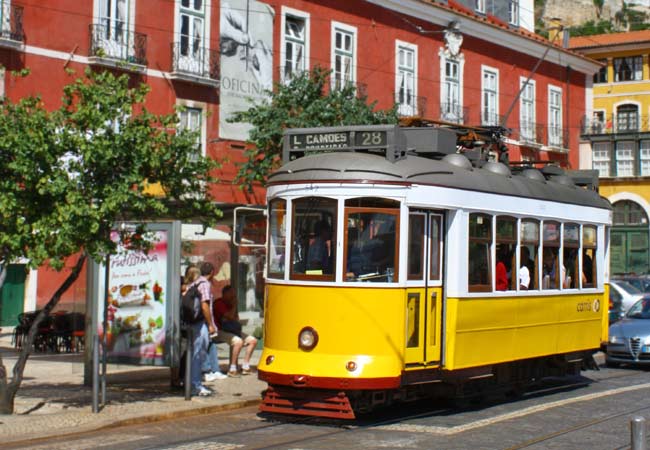
The 12 has a longer story than its short route suggests. Its roots reach back to 1893, when a tram first climbed the hill from Rua da Palma up to Graça. That early service stopped in 1913, but part of it was revived in 1915, and it has rattled along as the electric 12E ever since.
For most of its life the 12 was a loop. You could board at Martim Moniz, ride up through Mouraria and Alfama, take in the views at Santa Luzia, and come back round to where you started without paying a return fare. It was a neat little circuit of the old city, that ran from 1997 to 2024 known as the Circulação Castelo.
That is no longer the case. In recent years the loop was scrapped, and the 12 now runs in a straight line from Martim Moniz up through Alfama and down to Praça Luís de Camões in Chiado. Do not be surprised if the maps you find online disagree with one another.
The Remodelado trams of route 12
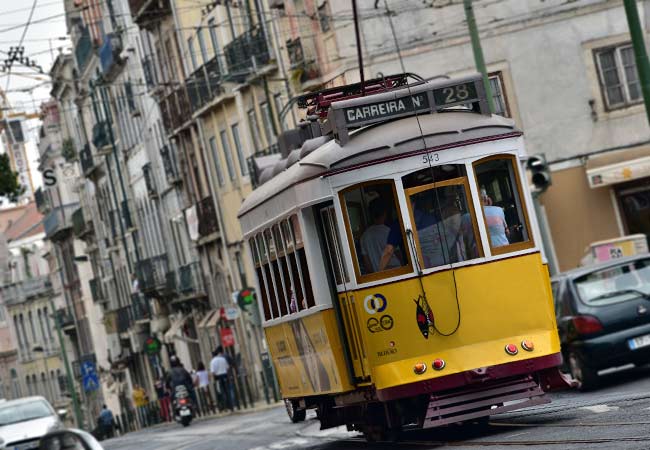
The cheery yellow Remodelado trams, you will hear the tram before you see them. The screech of metal on metal as it leans into a tight corner and the clatter over the ancient points.
The name simply means "remodelled", as that is what they are. The bodies of these trams date back to the 1930s, when Carris built them based on the design of the American Brill trams. In 1995 the company took 45 of these old cars and fitted them with new trucks, motors, brakes and electrics, so what you ride today is a 1930s tram with a modern heart. They kept the wooden interiors, the polished fittings and the upright driver's controls, and upgraded everything for safety.
So why has Lisbon hung on to trams that are pushing a hundred years old, when most cities scrapped theirs decades ago? The answer is the city itself, the streets here are too narrow and too steep for the longer modern trams, and when the network was modernised in the 1990s, only the flat number 15 route could take the bigger Siemens trams. Everywhere else, the little four-wheelers were the only thing that could squeeze through. Stand at a tight bend in Alfama and watch one go by, and you will see what I mean, with the corners of the tram missing the edges of the buildings by inches. No other city in Europe still runs trams this old in everyday service, which is part of what makes a ride here feel so special.
They are small inside, with only around twenty seats and standing room for the rest. There are high steps up at the door and no ramp, so the Remodelado trams are not suitable if you have a pushchair, heavy luggage or trouble with steps.
Discover more of Lisbon with our most popular guides


If you've found our content valuable, we'd welcome your support.
The digital publishing landscape has evolved significantly. As a small independent publisher, we face growing challenges. Search engines increasingly favour paid content over organic results, while AI-generated content often reproduces original work without attribution.
To support our work, please consider bookmarking this page (press Ctrl + D) for quick access. If you find an article helpful, we'd be grateful if you'd share it with friends on social media.
For specific questions, please see our Reddit community at r/LisbonPortugalTravel.
Should you notice any outdated or incorrect information, please contact us at [email protected]
Thank you for helping us continue to provide valuable content in an increasingly challenging digital environment.
A complete list of all of our Lisbon articles
 -
-


If you've found our content valuable, we'd welcome your support.
The digital publishing landscape has evolved significantly. As a small independent publisher, we face growing challenges. Search engines increasingly favour paid content over organic results, while AI-generated content often reproduces original work without attribution.
To support our work, please consider bookmarking this page (press Ctrl + D) for quick access. If you find an article helpful, we'd be grateful if you'd share it with friends on social media.
For specific questions, please see our Reddit community at r/LisbonPortugalTravel.
Should you notice any outdated or incorrect information, please contact us at [email protected]
Thank you for helping us continue to provide valuable content in an increasingly challenging digital environment.