LisbonLisboaPortugal.com
The best independent guide to Lisbon
LisbonLisboaPortugal.com
The best independent guide to Lisbon
Igreja de São Domingos: The fire burnt church of Lisbon
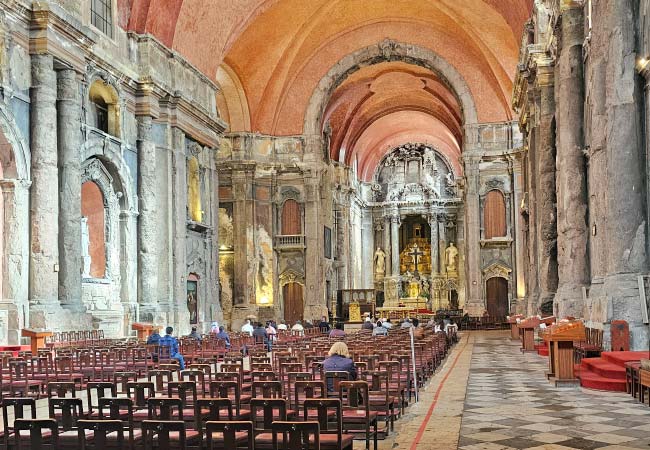
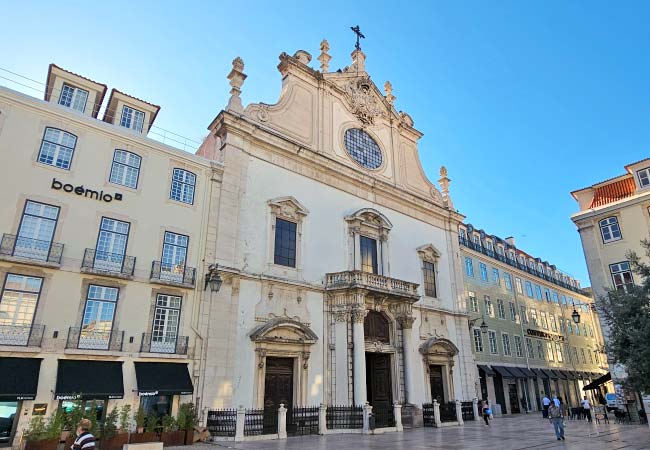
No church in Lisbon tells a more dramatic story than São Domingos. From the bustling squares of Rossio and Figueira, its calm Baroque facade gives no hint of the extraordinary interior that awaits. Step inside, and you enter one of Europe's most moving sacred spaces: a church that wears its wounds with dignity, where fire-blackened columns and cracked stone walls have been deliberately preserved as monuments to survival.
This is not a conventional restoration. When a catastrophic fire gutted São Domingos in 1959, killing two firefighters and destroying centuries of gilded artwork, the city made a radical decision. Rather than restore the church to its former glory, they chose to preserve the scars. The result is a space that exists somewhere between holy and haunted, where terracotta-coloured burn marks climb the walls like abstract frescoes and fractured pillars stand as witnesses to destruction.
But São Domingos was already a survivor long before 1959. This church has been destroyed and rebuilt three times, surviving the earthquakes of 1531 and 1755, serving as the starting point for the horrific 1506 massacre of Lisbon's Jews, and functioning as the ceremonial stage for the Portuguese Inquisition. Today, in a profound transformation, its square has become the heart of Lisbon's African community, continuing a connection that stretches back 500 years to the first African brotherhoods that fought for emancipation within these very walls.
Tourist Information for the Igreja de São Domingos
Igreja de São Domingos welcomes visitors daily from 7:00 AM to 7:00 PM, with free admission making it accessible to all. Located at Largo de São Domingos in the Baixa district, the church sits just steps from Rossio Square and the National Theatre D. Maria II.
Mass is held Monday through Friday at 7:15 PM, Saturdays at 8:30 AM and 6:00 PM, and Sundays at noon and 6:00 PM. Visitors during services should enter quietly and remain at the back unless participating in worship.
A visit typically takes 20-30 minutes, though the emotional impact may linger much longer. The church is fully accessible at ground level, with the main nave offering unobstructed views of the preserved fire damage.
A Chronicle of Catastrophe and Resilience
1241: Founded by King Sancho II as Lisbon's first Dominican church, it grew to become the city's largest religious building
1506: The Lisbon Massacre begins here when Dominican friars incite violence against New Christians (converted Jews), leading to three days of murder that killed hundreds or possibly thousands
1531: First major earthquake damages the medieval structure, requiring extensive reconstruction
1551: The Brotherhood of Our Lady of the Rosary splits into two branches, with one specifically for "black freedmen and slaves" fighting for emancipation
1748: Royal architect João Frederico Ludovice completes the magnificent Baroque altar that would miraculously survive all future disasters
1755: The Great Lisbon Earthquake destroys the church almost completely; only Ludovice's altar and the sacristy survive
1807: After 52 years of reconstruction, the church reopens in lavish Baroque-Mannerist style
1959: On August 13, a devastating fire visible from Lisbon's seven hills requires 100 fire engines and six hours to control, killing two firefighters and gutting the interior
1994: Church reopens after radical restoration that preserves fire damage as a deliberate act of memory
The Fire of 1959
August 13, 1959, transformed São Domingos forever. The fire that erupted that day was so massive it could be seen from all seven hills of Lisbon. One hundred fire engines responded to the inferno, which took more than six hours to extinguish. When the smoke finally cleared, two brave firefighters had lost their lives, and the church's sumptuous interior of gilded woodcarving and priceless paintings had been reduced to ash and rubble.
For 35 years, the church remained a burnt-out shell, its future uncertain. When restoration finally began, church authorities and city leaders made an unprecedented decision. Instead of rebuilding São Domingos to its former splendor, they would preserve the fire damage. No fresh paint would cover the scorched walls. No plaster would hide the cracked stone. The burn marks would remain, transforming the church into something entirely new: a sacred space that refused to hide its wounds.
This choice aligned São Domingos with another of Lisbon's great ruins, the Convento do Carmo, which has stood roofless since the 1755 earthquake. Both buildings now serve as powerful memorials to catastrophe, but while Carmo remains frozen in 1755, São Domingos lives on as an active place of worship where the scars themselves have become sacred.
Inside the Wounded Church
Entering São Domingos feels like stepping into a living archaeological site. The immediate impression is overwhelming: walls stained in gradients from soot-black to burnt orange create an inadvertent colour palette no artist could replicate. Massive stone pillars show visible fractures where the intense heat cracked the limestone. The very architecture bears witness to temperatures that buckled marble and warped stone.
Look up, and you'll see where the ceiling has been stabilized but not cosmetically repaired. The new roof structure, clearly modern, makes no attempt to blend with the original architecture. This honesty extends throughout the space: reinforced sections are obvious, safety additions are undisguised, and the boundary between old and new remains deliberately visible.
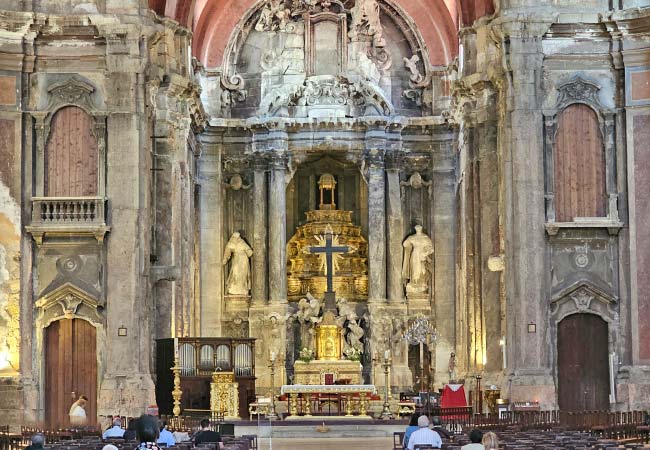
Yet amid this deliberate preservation of damage, certain elements shine with undiminished glory. The red marble high altar, designed by João Frederico Ludovice in 1748, survived both the 1755 earthquake and the 1959 fire. This Baroque masterpiece depicting the Holy Trinity stands as the church's beating heart, its survival through multiple catastrophes adding layers of meaning to its religious significance.
The surviving religious art takes on new poignancy in this context. Statues missing limbs from the fire remain in place, their damage incorporated into their meaning. Paintings darkened by smoke hang beside walls that tell their own story of survival. Even the modern additions, including contemporary artworks installed since 1994, dialogue with the scars rather than trying to hide them.
Take time to examine the information boards titled "Fire in the House of God," which include photographs from the 1959 disaster. These images help visitors understand the scale of destruction and the radical nature of the restoration choice. The contrast between these photos and the current state reveals how carefully the damage has been stabilized while remaining visible.
The Darker Chapters: Massacre and Inquisition
Long before the fire, São Domingos was already marked by tragedy. In April 1506, during a time of plague and drought, the church became ground zero for one of Portugal's darkest moments. When a New Christian (a forcibly converted Jew) suggested that a supposed miracle on the altar was merely a trick of the light, Dominican friars incited the crowd to violence. What followed was three days of murderous rampage through Lisbon's streets, claiming hundreds or possibly thousands of Jewish lives.
The church's dark role continued through the centuries of the Portuguese Inquisition. São Domingos formed part of a geographic triangle of terror with the Palace of the Inquisition (now the site of the National Theatre) and Rossio Square, where executions took place. Inside São Domingos, the sentences of the condemned were read aloud in elaborate ceremonies called autos-da-fé, after which victims were led to their deaths in the adjacent square.
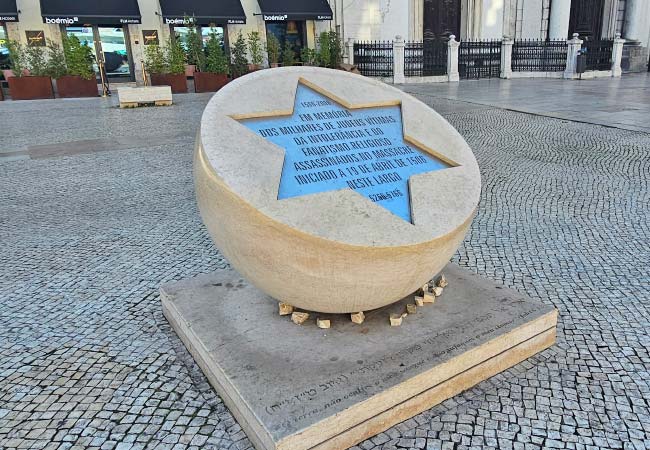
Today, a memorial in the Largo de São Domingos, installed in 2008, acknowledges this history. Inscribed with "Lisbon, City of Tolerance" in 34 languages, it stands as an admission of past intolerance and a commitment to a different future. The memorial's location directly in front of the church ensures that no visitor can ignore this essential chapter of the building's story.
The African Heart
Today's visitors will immediately notice that the Largo de São Domingos serves as the primary gathering place for Lisbon's African community, particularly immigrants from former Portuguese colonies. The Igreja São Domingos has always had a strong African connection as traditionally, the priest originated from Africa and was able to support new immigrants during their transition into Portugal.
This might seem like a recent, post-colonial development, but archival evidence reveals a much deeper history.
As early as 1551, São Domingos hosted the Brotherhood of Our Lady of the Rosary, which formally divided to create a branch specifically for "black freedmen and slaves of Lisbon." This brotherhood fought for the emancipation of enslaved members, making the church a center of African resistance and community organization during the height of the slave trade. The connection between São Domingos and Lisbon's African population is therefore not decades but centuries old.
This presents the profound paradox of São Domingos: the same building that served as a stage for the Inquisition's condemnations simultaneously functioned as a base for African liberation movements. Today's vibrant African presence in the square is not a break from history but its continuation, transforming a space of former oppression into one of community and cultural celebration.
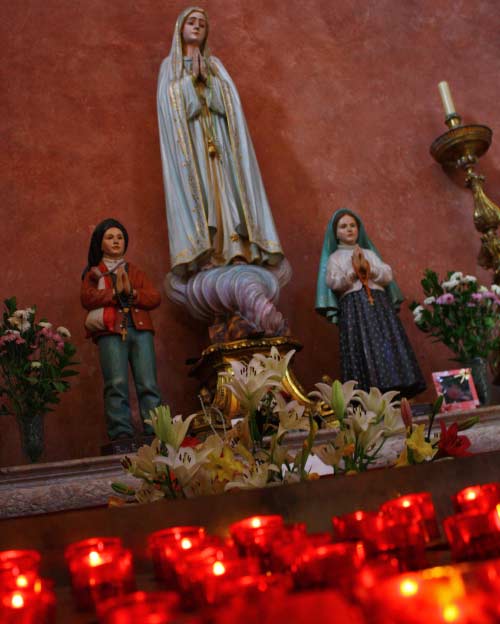
Fatima and the shepherds statue in the Igreja São Domingos
Discover more of Lisbon with our most popular guides


About this guide: I'm Philip Giddings. I live in Graça with my Portuguese wife Carla, whose family are Lisboetas going back generations. I've been visiting Portugal since 2001, writing the independent guides at LisbonLisboaPortugal.com since 2009, and the site is now my full-time work. Carla first brought me up to Lisbon on an early trip, and twenty-five years on we are still walking the city together: summers on the packed beaches, quiet Saturdays at the Feira da Ladra, and hunting for a heater for our flat when the chilly winter arrives.
This site has 189 guides on Lisbon. It takes no payment from tourist boards, tour operators, or attractions for inclusion, and is funded by affiliate commissions on tour bookings, disclosed on every page that contains them. Every practical detail (ticket prices, opening hours, bus routes, time-slot policies) is checked against the official sources and verified in person on the walks I make through the city each week. Read the full story here.