LisbonLisboaPortugal.com
The best independent guide to Lisbon
LisbonLisboaPortugal.com
The best independent guide to Lisbon
Convento da Graça, Lisbon: the church on Lisbon's highest hill
High on the hill above Alfama, set back from the famous viewpoint of the Miradouro da Graça, stands a church that most visitors walk straight past. They climb up for the view, take their photographs of the castle and the Tagus, settle in at the kiosk café, and head back down without ever crossing the small square to look inside. That is a small tragedy, because the Convento da Graça is one of the most quietly remarkable buildings in Lisbon, and in 2017 it finally opened its doors to visitors after centuries closed to the public.
The convent has been here, in one form or another, since 1271. King Afonso III founded it on the hill where, a hundred and twenty years earlier, Afonso Henriques had positioned his troops for the siege that took Lisbon back from the Moors. The Augustinian friars made it their headquarters in Portugal, and over the next five centuries it grew into one of the great religious houses of the city, with thirteen chapels and a community of fifty monks.
Then came the morning of 1 November 1755. The earthquake that destroyed half of Lisbon brought down most of the convent with it. What you see today is largely the rebuild that followed in the restrained Pombaline style of the late 18th century, but the older building is still there if you know where to look. The bell tower above the main entrance, completed in 1738 by the architect Manuel da Costa Negreiros, came through the earthquake intact. The 17th-century bell hanging inside it has been ringing out across the Alfama for more than 350 years, through earthquakes, revolutions, and the slow turning of the city below.
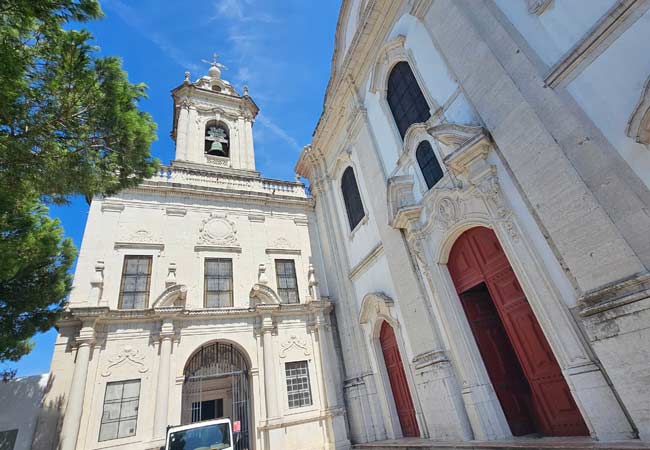
The entrance to the Graça church (right) and the convent (left)
What to see inside the church
Step inside and the first thing that strikes you is the height of the nave. It is taller and broader than most of its Pombaline neighbours, a clue that this church was built on the bones of something older and grander. Before the earthquake it had three naves rather than one, and you can still trace the outline of the original side chapels behind the gilded altars.
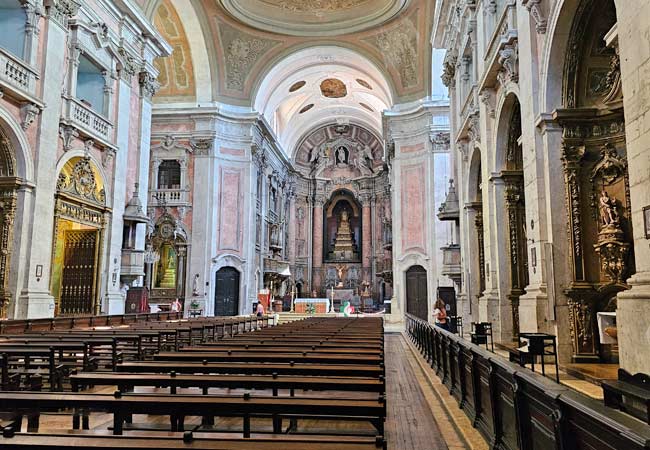
The most important of those altars is in the chancel, and it holds the tomb of Afonso de Albuquerque. If the name does not mean much to you now, give it a moment. Albuquerque was the man who built Portugal's empire in the East, the conqueror of Goa and Malacca, the architect of a trading network that stretched from East Africa to the South China Sea. Before he sailed for India in 1503, he founded a chapel here in the Graça. When he died in 1515 his body was eventually brought home, and in 1566 it was reinterred in the chancel where it lies today. For anyone with even a passing interest in the Age of Discovery, this is one of the most significant tombs in the country, and almost nobody knows it is here.
Take your time with the side chapels too. The current baptistery, tucked off to one side, is a 16th-century Manueline survivor with a vaulted ceiling and the tombs of the convent's founders. At its centre sits a marble basin that was once the lavabo where the friars washed their hands before mass, now quietly repurposed as a font. It is the kind of detail that no guidebook will tell you about, and the kind that rewards a slow visit.
Look up before you leave. The ceiling of the nave was painted by Pedro Alexandrino de Carvalho, the most prolific church painter of 18th-century Lisbon, whose work you will also see in the cathedral and at Queluz. The trompe l'oeil work in the sacristy, with its painted marble and grisaille figures, is among the finest of his career.
What to see in the convent
For most of its history, the convent itself was closed to outsiders. After the religious orders were dissolved in 1834, the army moved in and stayed for the better part of two centuries, adding the battlemented walls and corner towers that still give the complex its faintly military air. It was not until 2017, after a long restoration, that the cloisters and conventual buildings finally opened to the public.
They are well worth the small detour from the church. The main cloister is a calm two-storey square, with the lower arcade built in the Mannerist style of the late 16th century. Take the stairs to the upper floor and walk to the eastern end of the old dormitory wing. There you will find the mirante, the friars' contemplation room, and what is to my mind the most affecting space in the whole complex.
The mirante's walls are covered in tiles. On one side, the saints and reformers of the Augustinian order, ranked in solemn rows. On the other, the temptations of earthly pleasures, with all the colour and movement that implies. A cistern sits in the middle of the floor. Standing in that small room with the light coming through the windows, it is not difficult to imagine the kind of life the friars led here, weighing one against the other, year after year. No other monastic interior in Lisbon makes the daily texture of that life so immediate.
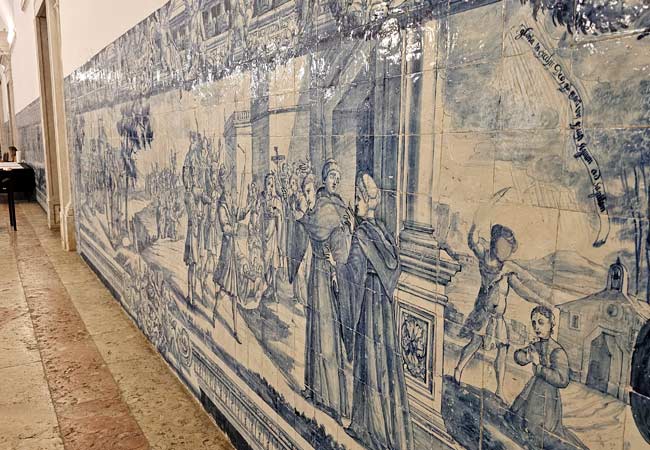
The tile work is worth dwelling on more broadly. The convent holds one of the richest collections of azulejos in the city, spanning four centuries, from the 16th-century geometric patterns to the Pombaline panels in the cloisters and the 19th-century work in the later wings. If you have any interest in Portuguese tilework at all, this is one of the best places in Lisbon to see it in its original setting rather than behind glass in a museum.
The rooftop terrace
In 2023, the convent opened a new draw for visitors: the rooftop terrace, accessed through the bell tower at the main entrance. It is a small, paid-for experience that adds a fine view to a fine building.
You climb the stairs through the gatehouse, past the bell that survived the earthquake, and emerge on a terrace that looks straight out over the rooftops of the Alfama, the castle of São Jorge to one side, and the Tagus stretching away to the south. It is a quieter and more contained view than the famous one from the miradouro next door, and a more interesting one too, because you are looking out from the building you have just been exploring rather than at it from the outside.
The ticket is currently five euros, with a reduced rate for children, and includes a drink at the café below. You can buy it on the door or online in advance. It is open every day, and given how few people seem to know about it, you will rarely have to queue.
A living church
For all its history, the Graça is not a museum piece. It is still the parish church for this corner of Lisbon, and on any given morning you will find candles burning, flowers on the altars, and locals slipping in to pray. The most important moment in its calendar is the Procissão do Senhor dos Passos da Graça, held on the second Sunday of Lent, which has been making its way between the Igreja de São Roque and the Graça without interruption since 1587. If your visit happens to fall on that weekend, set aside the morning for it. Few processions in Europe carry that weight of continuity, and watching it wind up the hill towards the church is one of the most striking things you can see in Lisbon.
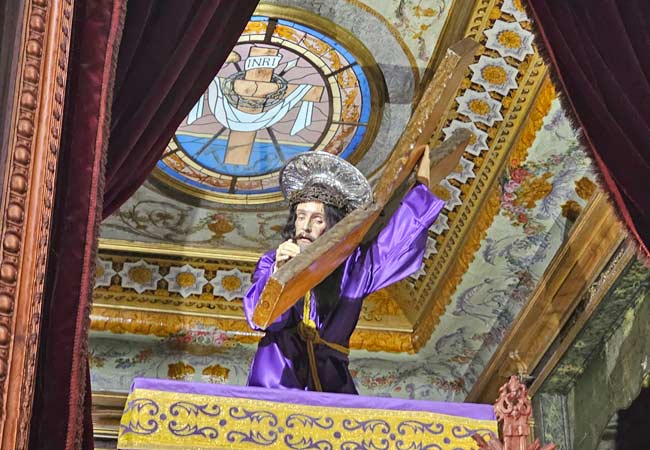
The Senhor dos Passos da Graça statue
Getting there and practicalities
The Convento da Graça stands on Largo da Graça, on the highest hill of central Lisbon. The simplest way to reach it is the number 28 tram, which climbs up from Baixa through the Alfama and stops just behind the church. The number 12 tram and the 734 bus also pass within easy walking distance. If you are coming up on foot from the Alfama, take it slowly: the streets are steep, the cobbles are uneven, and there are too many small things to look at along the way to rush.
The church and the cloisters are free to enter. Only the rooftop terrace requires a ticket. Opening hours are generally daily, but the convent does close occasionally for private events, so it is worth checking before you make a special trip.
A final piece of advice. Do not try to fit the Graça into a fast circuit of the Alfama miradouros. The church alone deserves half an hour, the convent another half an hour, and the terrace a quiet twenty minutes with a coffee afterwards. Build it into the morning rather than the afternoon if you can, when the light comes through the eastern windows of the mirante and the tiles are at their best.
Most people climb this hill for the view. Take the view, of course. But save an hour for the church and convent next door. They have been waiting on this hilltop for more than 750 years, and they have more to say than almost anything else in the neighbourhood.
Discover more of Lisbon with our most popular guides


About this guide: I'm Philip Giddings. I live in Graça with my Portuguese wife Carla, whose family are Lisboetas going back generations. I've been visiting Portugal since 2001, writing the independent guides at LisbonLisboaPortugal.com since 2009, and the site is now my full-time work. Carla first brought me up to Lisbon on an early trip, and twenty-five years on we are still walking the city together: summers on the packed beaches, quiet Saturdays at the Feira da Ladra, and hunting for a heater for our flat when the chilly winter arrives.
This site has 189 guides on Lisbon. It takes no payment from tourist boards, tour operators, or attractions for inclusion, and is funded by affiliate commissions on tour bookings, disclosed on every page that contains them. Every practical detail (ticket prices, opening hours, bus routes, time-slot policies) is checked against the official sources and verified in person on the walks I make through the city each week. Read the full story here.
 -
-
If you've found our content valuable, we'd welcome your support.
The digital publishing landscape has evolved significantly. As a small independent publisher, we face growing challenges. Search engines increasingly favour paid content over organic results, while AI-generated content often reproduces original work without attribution.
To support our work, please consider bookmarking this page (press Ctrl + D) for quick access. If you find an article helpful, we'd be grateful if you'd share it with friends on social media.
For specific questions, please see our Reddit community at r/LisbonPortugalTravel.
Should you notice any outdated or incorrect information, please contact us at [email protected]
Thank you for helping us continue to provide valuable content in an increasingly challenging digital environment.