LisbonLisboaPortugal.com
The best independent guide to Lisbon
LisbonLisboaPortugal.com
The best independent guide to Lisbon
The Peacocks of Lisbon Castle and Alfama
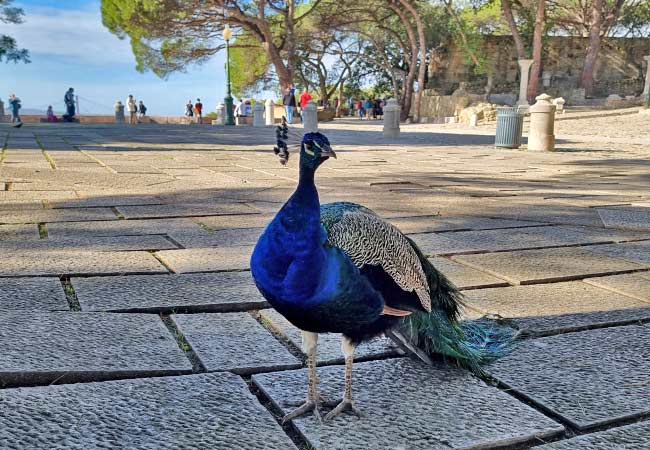
If you visit the Castelo de São Jorge (and you should) there is a reasonable chance your most vivid memory will not be the panoramic views over the Tejo or the eleven towers you can climb, but a large iridescent bird screaming at you from a garden path like an affronted landlord.
Around 40 Indian peafowl live within the castle grounds, and they have become as much a part of the experience as the battlements themselves. They strut through the courtyards, perch on ancient walls, roost in the stone pines overhead, and occasionally glide from the ramparts with a wingspan that catches first-time visitors completely off guard. They are beautiful, bold, and surprisingly loud. Understanding why they are here, and how they ended up living in a medieval fortress in the middle of a European capital, makes the encounter considerably more interesting.
Why are there peacocks at Lisbon castle?
The short answer is Vasco da Gama and a king with expensive taste.
When da Gama returned from his first voyage to India in 1498, he was formally received at the castle by King Manuel I, known to history as "The Fortunate." That voyage cracked open the maritime spice trade and, along with it, access to the exotic flora and fauna of the Indian subcontinent. Manuel I was not the sort of monarch to let that opportunity pass quietly. He established a royal menagerie within the castle grounds that at various times included lions from Africa and exotic birds from the East, and the Indian peacock, native to the subcontinent and already laden with royal symbolism, was a particular prize.
The birds were installed in the royal gardens as living proof of the King's global reach. Even after the court relocated downhill to the Ribeira Palace in 1511, the castle continued to host exotic species as part of its identity. The peacocks you see today are the direct descendants of that tradition, and while the population has been carefully managed over the centuries, the link back to the Age of Discovery is genuine.
During the major restoration of the castle between 1938 and 1944, the gardens were redesigned and the peacock population was formally maintained as part of the site. So while the birds carry five centuries of royal heritage, their current habitat (the peaceful gardens and mature pine trees within the courtyards) is largely a 20th-century creation, much like the restored battlements around them.
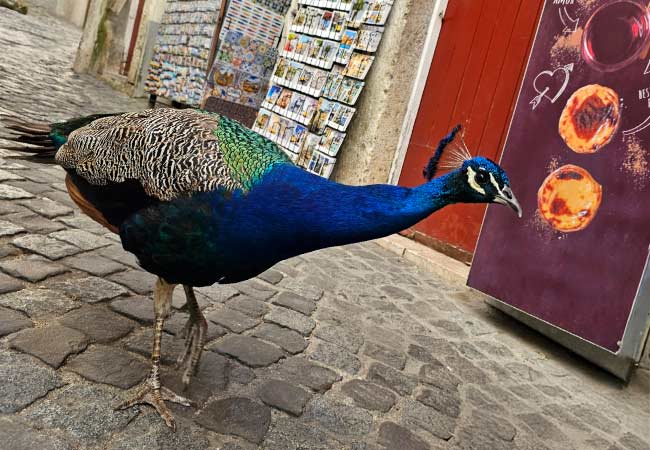
Even the Portuguese Peacocks love Pastel de nata
How many peacocks are there?
The current population sits at roughly 40 individuals. That number is actively managed rather than left to chance; the castle works with a specialist exotic animal veterinary clinic called the Exoclinic, whose team monitors the birds' health, controls population size to prevent overstressing the grounds, and microchips every chick born in the spring.
Nesting typically happens in April and May, with chicks (properly called peachicks) hatching in late spring or early summer. If you visit during that window, you stand a good chance of spotting the young ones trailing after the females through the garden paths.
The white peacocks and other rare variants
One of the first things visitors notice is that not all the peacocks look the same. Alongside the classic iridescent blue-green males, the São Jorge population includes some genuinely striking variants.
The white peacocks are the ones that draw the most attention, and they are frequently mistaken for albinos. They are not. These birds are leucistic, which means a genetic mutation prevents pigment from being deposited in their feathers, producing that extraordinary pure white plumage. The giveaway is the eyes: an albino would have pink or red eyes, whereas the white peacocks at the castle retain perfectly normal dark eye pigmentation.
You may also spot what are sometimes called pied or marbled peacocks: birds that carry both the standard and leucistic genes, resulting in a patchwork of iridescent blue and white patches. Tourists often refer to these as "half-albinos," which is not technically accurate but gets the idea across well enough.
Can you feed the peacocks?
You can, but only with the right food, and this is a point the castle takes seriously.
Feeding the birds human food (bread, crisps, anything from your lunch) is strictly prohibited. It might seem harmless, but a diet of tourist snacks leads to genuine malnutrition and can shorten the birds' lives significantly. The castle's veterinary team from the Exoclinic has been clear on this, and the administration enforces the rule.
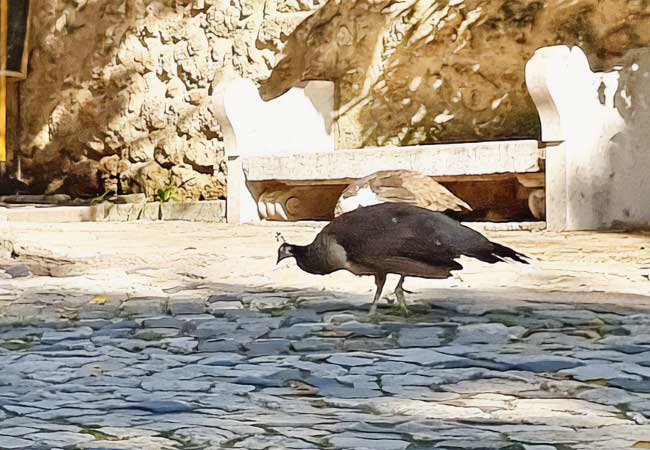
What you can do is buy packets of scientifically formulated peacock feed from the castle shop for a small fee. This gives you a way to interact with the birds safely, and the females and chicks in particular can be remarkably forward once they work out you might have something for them. "Very persistent" would be putting it mildly.
Are the peacocks friendly?
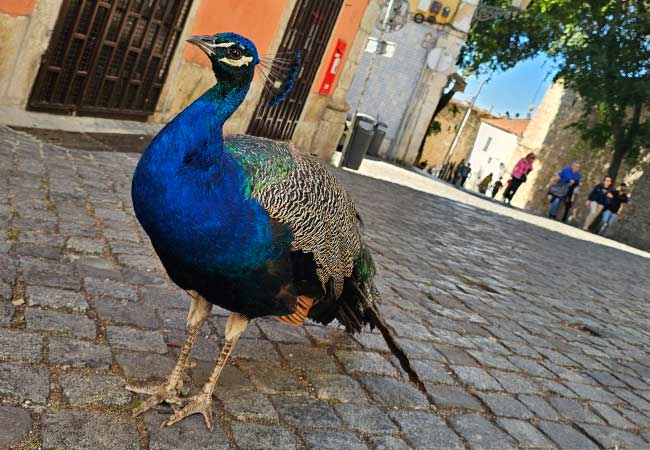
Friendly is probably the wrong word. Confident is closer to the truth.
The males tend to keep a regal distance, posing for photographs with an air of practised indifference. They will fan their trains and turn slowly as if they have done this a thousand times before, which, given the volume of tourists, they almost certainly have. The females and young birds are bolder when food is involved and will happily follow you along the garden paths if they think you are holding out on them.
The birds are free-roaming rather than caged, and they regularly wander beyond the castle walls into the surrounding streets of Alfama. Residents describe them as magnificent neighbours, and local stories of peacocks perched on residential walls or exploring the area near the Castle Elevator are common. They are, for all practical purposes, part of the neighbourhood.
One thing to be aware of: do not touch the birds. This is both a castle rule and common sense. Handling stresses them, risks damaging the plumage (which the males rely on for mating displays), and a startled peacock is not something you want to be on the wrong side of.
A male's train can include over 200 elongated upper tail coverts. When a male spreads those feathers into a full display, the Portuguese have a lovely phrase for it: fazer a roda, literally, "making the wheel."
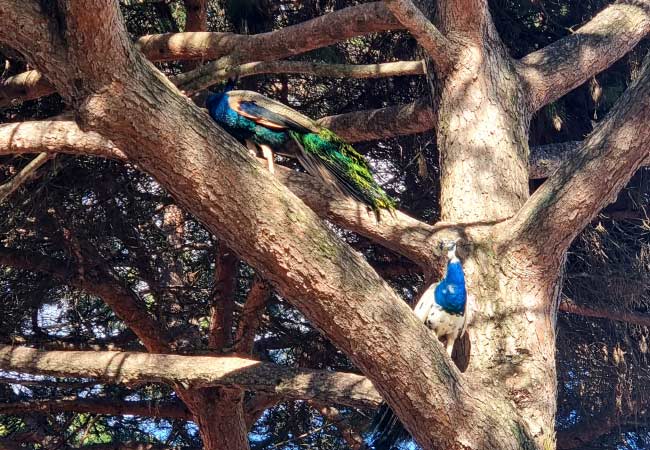
And somehow, they can fly. If you can’t spot the Peacock on your visit to the castle look up in the trees.
What are they called in Portuguese?
If you want to impress a local guide or simply know what you are reading on the information boards, the Portuguese names are gender-specific. The male peacock is a pavão (pa-VOW), the female peahen is a pavoa (pa-VOH-ah), and the chicks are pavõezinhos (pa-vow-AY-zeen-yos), which is frankly one of the more delightful words in the Portuguese language.
What is that terrible noise?
You will hear them before you see them, and your first thought will almost certainly not be "what a beautiful bird."
The peacock's call is famously awful. It has been described by visitors as sounding like a screaming cat, a person in distress, and (my personal favourite) a car alarm with feelings. The dissonance between the bird's extraordinary appearance and its voice is so stark that it catches people off guard every time. If you are sitting peacefully in the gardens of the Paço da Alcáçova enjoying the shade and the quiet, a peacock shriek at close range will solve that problem immediately.
There is a pleasing cultural footnote here as well. In Spanish, the peacock is called el pavo real, which translates literally as "the royal turkey." Watch a peacock waddling awkwardly across a cobbled path with its train dragging behind it, and the name starts to feel oddly appropriate.
The mythology behind the birds
The peacock's presence in a castle that has guarded Lisbon for nearly a thousand years carries more symbolic weight than you might expect.
In Greek mythology, the peacock was sacred to the goddess Hera. According to legend, when the hundred-eyed giant Argus Panoptes was killed, Hera placed his eyes into the peacock's tail so that his watchfulness would endure. A bird covered in eyes standing guard over a hilltop fortress: the symbolism almost writes itself.
In medieval Christian art, the peacock represented immortality and resurrection, based on an old belief that the bird's flesh did not decay after death. Given that the castle itself has survived Moorish sieges, Castilian invasions, and the catastrophic 1755 earthquake, there is something fitting about a symbol of endurance making its home here.
For Manuel I and the Portuguese crown, the birds served a more straightforward purpose: they were living emblems of imperial power, proof that the King's ships could reach India and bring back its treasures. That some of those treasures now wander freely through the Alfama asking tourists for snacks is, I think, one of history's more charming punchlines.
Tips for seeing the peacocks
The peacocks roam the full castle complex, but you are most likely to encounter them in the gardens surrounding the Paço da Alcáçova ruins and along the quieter paths away from the main viewpoints. Early morning and late afternoon tend to be the best times: the birds are more active, the light is better for appreciating the structural coloration, and there are fewer crowds competing for their attention.
If you are hoping to see a male in full display, spring is your best bet. The mating season runs roughly from April through the early summer, and this is when the males are most likely to fan their trains. Outside of that window, the males moult their long tail feathers and look considerably less impressive, still handsome birds, but without the full spectacle.
And if you spot one gliding from the battlements overhead, try not to flinch. They do it regularly, and the wingspan on a fully grown male passing two metres above your head is something you remember.
Discover more of Lisbon with our guides


About this guide: I'm Philip Giddings. I live in Graça with my Portuguese wife Carla, whose family are Lisboetas going back generations. I've been visiting Portugal since 2001, writing the independent guides at LisbonLisboaPortugal.com since 2009, and the site is now my full-time work. Carla first brought me up to Lisbon on an early trip, and twenty-five years on we are still walking the city together: summers on the packed beaches, quiet Saturdays at the Feira da Ladra, and hunting for a heater for our flat when the chilly winter arrives.
This site has 189 guides on Lisbon. It takes no payment from tourist boards, tour operators, or attractions for inclusion, and is funded by affiliate commissions on tour bookings, disclosed on every page that contains them. Every practical detail (ticket prices, opening hours, bus routes, time-slot policies) is checked against the official sources and verified in person on the walks I make through the city each week. Read the full story here.
 -
-


If you've found our content valuable, we'd welcome your support.
The digital publishing landscape has evolved significantly. As a small independent publisher, we face growing challenges. Search engines increasingly favour paid content over organic results, while AI-generated content often reproduces original work without attribution.
To support our work, please consider bookmarking this page (press Ctrl + D) for quick access. If you find an article helpful, we'd be grateful if you'd share it with friends on social media.
For specific questions, please see our Reddit community at r/LisbonPortugalTravel.
Should you notice any outdated or incorrect information, please contact us at [email protected]
Thank you for helping us continue to provide valuable content in an increasingly challenging digital environment.