LisbonLisboaPortugal.com
The best independent guide to Lisbon
LisbonLisboaPortugal.com
The best independent guide to Lisbon
Cristo Rei, the Christ Statue of Lisbon
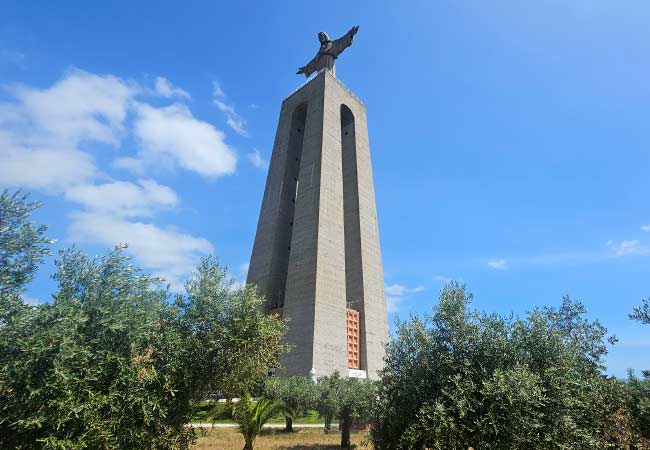
Cristo Rei stands with its arms outstretched over the southern bank of the Tejo, blessing Lisbon from the highest hill in Almada. The Christ figure itself is 28 metres tall, but it is the 82-metre pedestal beneath it that gives the monument its real presence, lifting the statue high enough that you can pick it out from almost anywhere in the city.
The idea was borrowed from Brazil. In 1934 Lisbon's Cardinal Patriarch visited Rio de Janeiro, was moved by Christ the Redeemer, and came home wanting something similar for Portugal. The monument that followed was built as an act of thanksgiving for the country having been spared the worst of the Second World War. Construction began in 1950, during a deeply religious and politically nationalistic period, and when Cristo Rei was finally consecrated in 1959 it became an immediate pilgrimage destination.
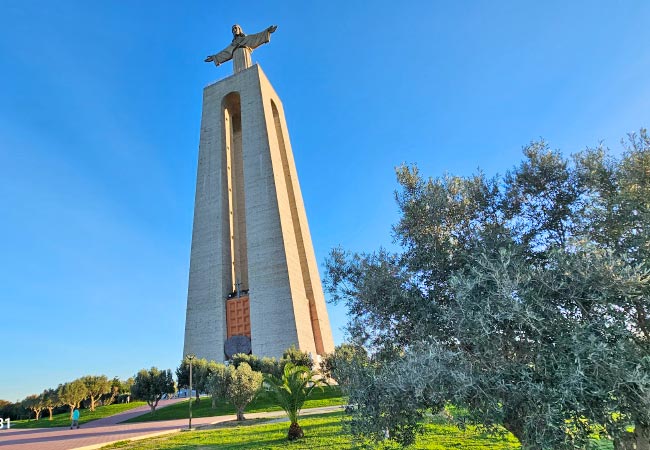
The Christ statue stands at the top of a 82m tower, and the hill it was constructed on, is the highest point of the region
It still is, but for most visitors today the draw is the view rather than the religion. From the terrace at the base of the statue the whole of Lisbon is laid out across the water, with the Ponte 25 de Abril stretching over the estuary in the foreground. It is one of the best panoramas of the city, and reaching it makes for an easy half-day trip, with the added bonus of an excuse to cross to the southern bank.
Getting there is straightforward. The route I always recommend is the ferry from Cais do Sodré to Cacilhas, then the short 3001 bus up the hill. If you are short on time or travelling with children, an Uber or Bolt does the job too. This guide covers everything you need to make the most of a visit to one of Lisbon's most famous monuments.
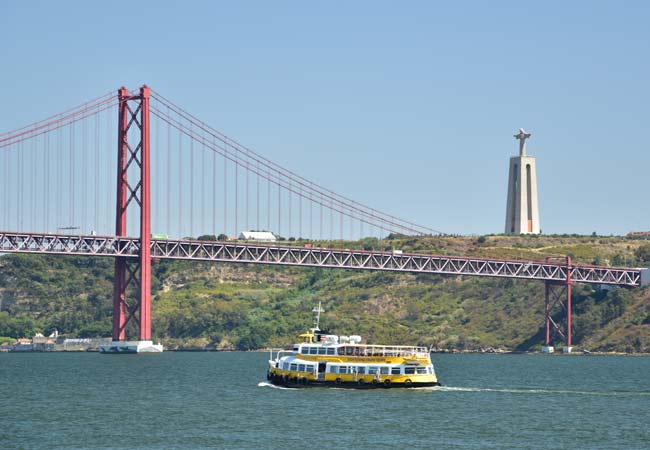
A tourist boat passing in front of the Cristo Rei statue
Visiting Cristo Rei: what I have learned
Cristo Rei is not just the statue, but a whole complex of pilgrimage buildings, gardens and cliff-top walks looking out over the Tejo and the suspension bridge. The grounds are free to enter and, because they are so large, it is easy to find quiet sections even when a tour coach or two has just arrived.
The only thing you actually pay for is the lift up to the viewing terrace at the top of the pedestal. Tickets cost €10 for anyone aged 13 and over, €3 for children aged 8 to 12, and are free for under-8s. An express lift whisks you up the 75 metres in moments, depositing you, slightly oddly, into a surprisingly large religious gift shop. From there it is a further 74 narrow spiral steps to the viewpoint itself, which means this final stretch is not suitable for wheelchair users or anyone with reduced mobility. The Cristo Rei entrance fee is not included in the Lisboa Card.
Honestly, I am not sure the ticket is worth it. The view from the top is breathtaking, and on a clear day you can pick out the Serra de Sintra 24km to the north-west and the Serra de Arrábida 27km to the south. But the terrace is wrapped in a high safety fence that gets in the way of every photo. One thing the terrace does have over the cliffs is a large hand-painted azulejo mural, its blue and white tilework said to depict scenes from the Book of Daniel, so do take a moment to look at it while you are up there.
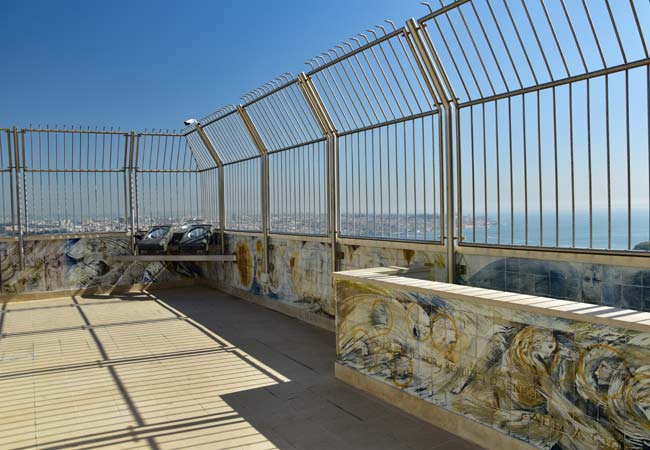
The viewing platform at the top of the Cristo Rei
The views from the cliff-top gardens are just as good, free, and far better for selfies or group shots with the bridge, the estuary or the city behind you. When I visited with my brother and his young family, it was the cliff-top group photos that went round the family WhatsApp group, while the paid terrace shots just stayed on my brother's phone.
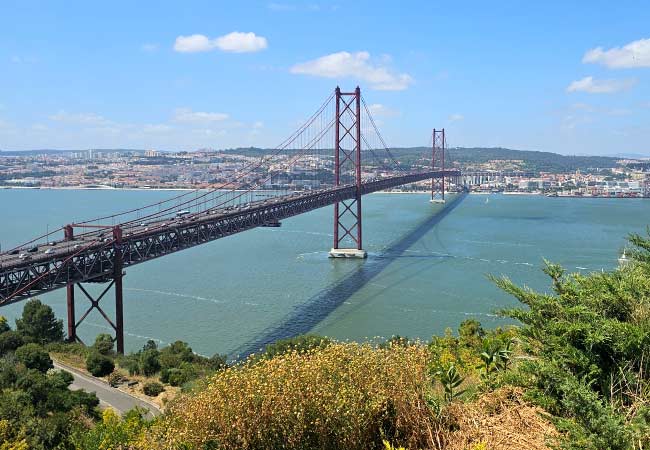
Some of the best views of the Ponte 25 de Abril bridge are from the viewpoint at the top of the cliffs.
A few practical details. The monument is open every day from 10am to 7pm between April and September, and 10am to 6pm from October to March, with last access 20 minutes before closing. This means you cannot catch sunset from the monument itself. As an alternative I would head down to the Jardim do Rio in Cacilhas, where you can watch the sun set over the Tejo estuary.
There can be a long queue to ride the lift to the viewing terrace, and the entrance is on the northern side, away from the ticket office. I would suggest before buying tickets, check the length of the queue and decide if you want to be stood in it for so long.
At the base of the statue is the Chapel of Our Lady of Peace, where mass is held in Portuguese on weekdays at 5pm, Saturdays at 12pm and 5pm, and Sundays at 11:30am and 5pm. The Cerger Cafeteria handles refreshments with basic meals, snacks and drinks, though reviews are mixed and you will eat far better down in Cacilhas. If you are driving, there is a large car park on site for €2, or free parking on the roads in front, but this does fill up at peak times with tour vehicles.
Cristo Rei remains an important pilgrimage site, and if you are organising a larger group visit the details are on cristorei.pt/
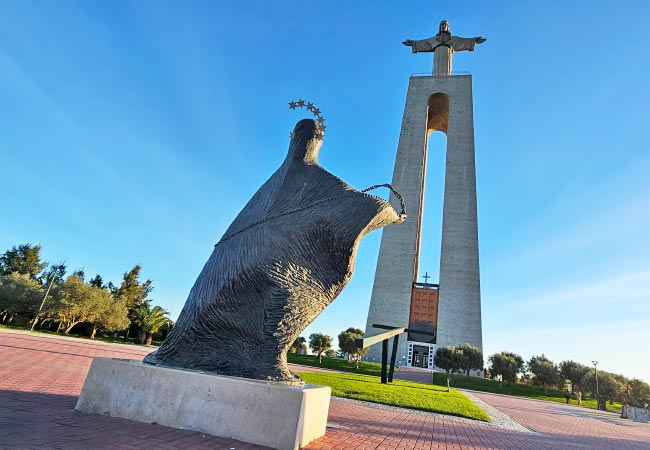
One small curiosity, about the site is the constant low hum across the gardens, and I was puzzled by this on my first visit in 2002. It is the traffic crossing the mesh deck of the Ponte 25 de Abril, carried all the way up the hill.
How about a small group tour?
One of the best ways to get to know Lisbon, and to meet a few fellow travellers along the way, is to join a guided tour. I have worked with Getyourguide.com for the last seven years, and some of their best Lisbon tours include:
The links above are affiliate links, and I earn a small commission if you book through them. I really appreciate it, as it helps me keep this website running.
Travel to the Christ Statue of Lisbon
The best way to reach Cristo Rei from Lisbon is the ferry and bus, and it is the route I have used for twenty-five years. You take the ferry from Cais do Sodré across to Cacilhas, then catch the 3001 bus for the final 3km up to the monument. The whole thing takes under an hour and costs next to nothing.
An Uber or Bolt will get you there faster, at around €12 for up to four people, and this is what I would choose if I were short on time or travelling with young children. Be warned that heavy traffic around the Ponte 25 de Abril can push the fare up considerably.
For a half-day trip, though, I would always take the ferry. The journey is part of the day out rather than something to be endured. You cross the estuary with the suspension bridge looming overhead, and you land in Cacilhas, a working waterfront town known for its fresh seafood at prices well below anything you will find on the Lisbon side.
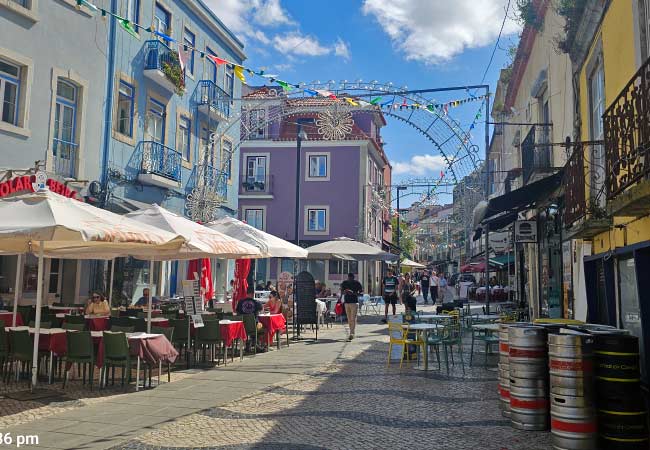
Cacilhas is famous for its sea food, and the only reason my Portuguese mother-in-law crosses to the south bank
The Ferry Journey
The crossing from Cais do Sodré to Cacilhas takes just 10 minutes and passes close to the Ponte 25 de Abril, with good views of it along the way. The Cais do Sodré terminal is the final stop on the green metro line and sits a short walk from the Baixa district, so it is easy to reach.
A single ferry fare costs €2.00, charged to a Navegante card, which is the reusable card used right across Lisbon's public transport network. Ferries leave roughly three times an hour, with more departures laid on at rush hour. If you can, avoid travelling at peak times, when the boat fills up with commuters and you may end up stuck in a middle aisle with no view at all. The latest timetable is on the Transtejo e Soflusa website: ttsl.pt
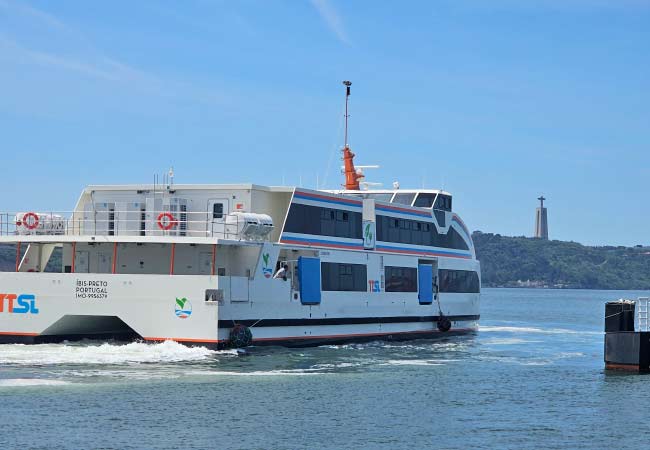
The new electric ferry that runs from Cais do Sodré across to Cacilhas. I find these much smoother and quieter than the old orange ferries, which used to leave me feeling seasick after even the shortest of crossings.
The Bus Journey
In Cacilhas the ferry terminal sits right beside the bus station, where the 3001 to Cristo Rei departs. The route runs directly to the foot of the monument, with two to three departures an hour in summer dropping to hourly in winter. Check current times on the Carris Metropolitana website:
www.carrismetropolitana.
The journey takes about 15 minutes, winding through Almada's residential streets before the final climb to the statue. The fare is €1.30 in cash, or €0.85 if you pay with Zapping credit on a Navegante card. Some buses also have a yellow validator where you can tap a contactless bank card, but I would always carry a bit of cash just in case.
While you wait for the bus, it is well worth wandering over to the Dom Fernando II e Glória, Portugal's last sailing warship, beautifully restored and moored in the docks right next to the station. She was launched in 1843 and is one of the real highlights of Cacilhas.

The 3001 bus waiting at Cacilhas
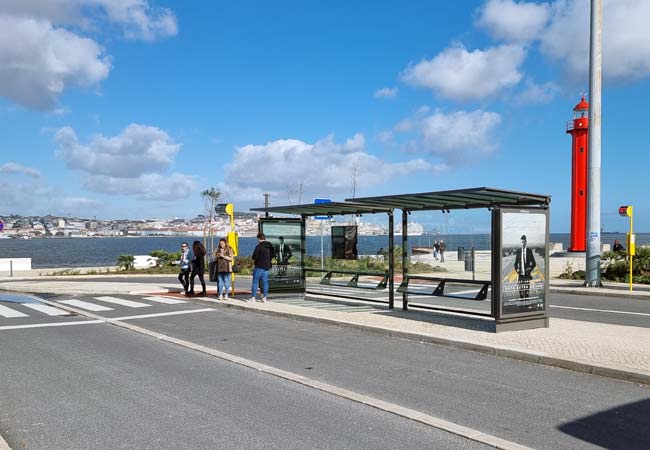
The bus stop for the 3001 bus in Cacilhas bus station
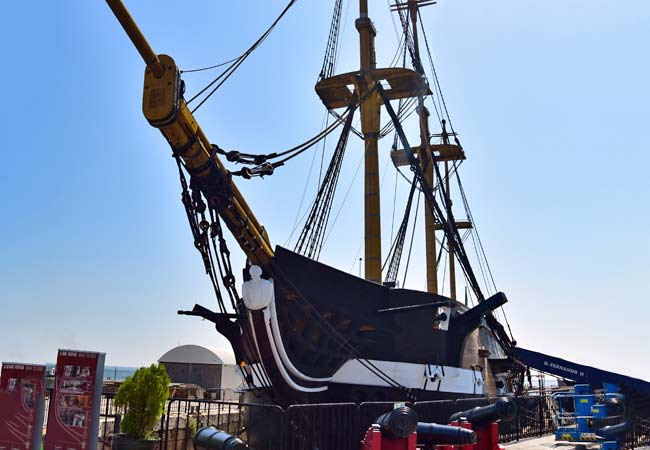
The lovingly restored Dom Fernando II e Glória; Portugal's last sailing warship
The walk from Cacilhas
It is possible to walk from the Cacilhas ferry terminal to Cristo Rei, but I would think twice before you do. The route follows the riverside Rua do Ginjal to the Boca do Vento lift, which carries you up to the cliff tops for free, and from there it is a further 1.8km to the monument. That second stretch is the problem. There is no direct path, and you wind uphill through bland residential streets with very little to see, looping out along the Avenida do Cristo Rei as the 3001 bus sails past you.
I have done this walk more than ten times over the years, and every single time, somewhere along that final climb with the sun beating down, I ask myself why I did not just take the bus. For a first visit, take the bus, and save the Rua do Ginjal for the stroll back down to the Jardim do Rio afterwards, when it comes into its own at sunset.
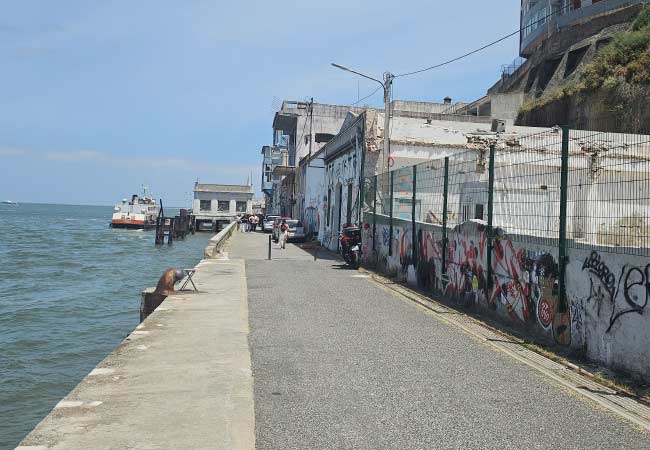
The Rua do Ginjal waterfront footpath could be one of the most scenic walks in Lisbon but currently it feels neglected
History of Cristo-Rei Lisbon
Cristo Rei was conceived during one of the darkest periods in European history. Portugal had been spared the devastation of the Second World War, and its deeply religious population wanted to give thanks for it. The monument is, at heart, an act of national gratitude set in concrete.
The spark came in 1934, when Lisbon's Cardinal Patriarch travelled to Rio de Janeiro and was so taken with Christ the Redeemer that he resolved to build something similar for Portugal. The idea then had to wait. It was not until the late 1940s that the Church secured the funding, by which point the project sat comfortably alongside António de Salazar's nationalistic dictatorship, which was happy to embrace religious monuments as symbols of Portuguese identity.
Work finally began in 1950 and ran for nine years. The Christ figure was the work of sculptor Francisco Franco de Sousa, and rather than being carved elsewhere and shipped in, it was sculpted in place on the hilltop. The finished statue stands 28 metres tall, with its open arms spanning exactly the same 28 metres across, and it was raised on a 82-metre reinforced concrete pedestal set on the highest point in Almada, 133 metres above sea level, which is what gives the monument its commanding view over the city.
On 17 May 1959, thousands gathered for the inauguration. Although the statue stands within the diocese of Setúbal, it was Lisbon's Catholic Church that paid for the whole construction, and in doing so created not only a place of pilgrimage but one of Portugal's most recognisable landmarks. Half a century later, in 2009, Pope Benedict XVI visited to mark the monument's golden anniversary, a sign of how firmly it had settled into Portuguese Catholic life.
Cristo Rei for visitors with limited mobility
Most of Cristo Rei is accessible to visitors with limited mobility. The complex sits on a flat summit, with gravel paths linking the gardens, the buildings and the main viewpoints, so getting around the grounds is straightforward.
The one exception is the viewing platform at the very top. The lift takes you most of the way up the pedestal, but the final stretch is a set of narrow spiral stairs of 74 steps with no accessibility lift. I would not let that put anyone off visiting, though. The views from the cliff-top gardens are every bit as spectacular, completely free, and fully accessible. You get the same sweeping panorama of Lisbon and the bridge with no barriers and no stairs to worry about.
Discover more of Lisbon with our most popular guides


About this guide: I'm Philip Giddings. I live in Graça with my Portuguese wife Carla, whose family are Lisboetas going back generations. I've been visiting Portugal since 2001, writing the independent guides at LisbonLisboaPortugal.com since 2009, and the site is now my full-time work. Carla first brought me up to Lisbon on an early trip, and twenty-five years on we are still walking the city together: summers on the packed beaches, quiet Saturdays at the Feira da Ladra, and hunting for a heater for our flat when the chilly winter arrives.
This site has 189 guides on Lisbon. It takes no payment from tourist boards, tour operators, or attractions for inclusion, and is funded by affiliate commissions on tour bookings, disclosed on every page that contains them. Every practical detail (ticket prices, opening hours, bus routes, time-slot policies) is checked against the official sources and verified in person on the walks I make through the city each week. Read the full story here.